


Page 34 - Math 7
P. 34
Number Systems in Diff erent Bases


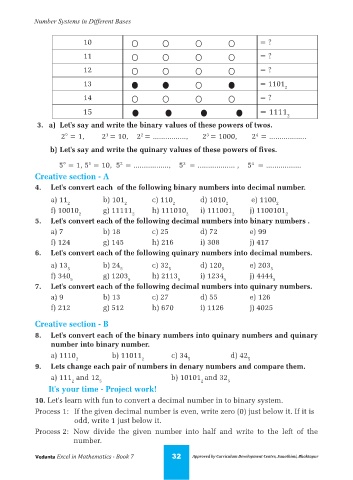
                         10                                                         = ?
                         11                                                         = ?

                         12                                                         = ?
                         13                                                         = 1101 2

                         14                                                         = ?
                         15                                                          = 1111 2

            3.  a)  Let's say and write the binary values of these powers of twos.
                                          2
                                                             3
                       2° = 1,    2 = 10,    2 = ................,       2 = 1000,       2 = ..................
                                1
                                                                           4
                b)  Let's say and write the quinary values of these powers of fives.
                  5° = 1, 5  = 10,  5 = .................,    5 = .................. ,    5 = .................
                           1
                                    2
                                                                          4
                                                      3
           Creative section - A
           4.  Let's convert each  of the following binary numbers into decimal number.
                a) 11 2        b) 101 2      c) 110 2      d) 1010 2      e) 1100 2
                f) 10010       g) 11111      h) 111010     i) 111001      j) 1100101
                        2              2               2            2               2
           5.  Let's convert each of the following decimal numbers into binary numbers .
                a) 7           b) 18         c) 25         d) 72          e) 99
                f) 124         g) 145        h) 216        i) 308         j) 417
           6.  Let's convert each of the following quinary numbers into decimal numbers.
                a) 13 5        b) 24 5       c) 32 5       d) 120         e) 203
                                                                 5
                                                                                5
                f) 340         g) 1203       h) 2113       i) 1234          j) 4444
                     5                5              5            5             5
           7.  Let's convert each of the following decimal numbers into quinary numbers.
                a) 9           b) 13         c) 27         d) 55          e) 126
                f) 212         g) 512        h) 670        i) 1126        j) 4025

           Creative section - B
           8.  Let's convert each of the binary numbers into quinary numbers and quinary
                number into binary number.
                a) 1110 2         b) 11011 2       c) 34 5          d) 42 5
           9.  Lets change each pair of numbers in denary numbers and compare them.
                a) 111  and 12 5                   b) 10101 and 32 5
                      2
                                                           2
                 It's your time - Project work!
           10. Let's learn with fun to convert a decimal number in to binary system.
           Process 1:   If the given decimal number is even, write zero (0) just below it. If it is
                       odd, write 1 just below it.
           Process 2:  Now divide the given number into half and write to the left of the
                      number.

           Vedanta Excel in Mathematics - Book 7   32    Approved by Curriculum Development Centre, Sanothimi, Bhaktapur

