


Page 8 - Math 7
P. 8
Set
The membership of a member of a set is denoted by the symbol ‘'. For example,
1N or 1{ 1, 2, 3, 4, 5}. We read it as '1 belongs to set N' or '1 is a member of set N'
or 1 is an element of set N. Similarly, 2N, 3N, 4N and 5N.
However, when any element is not a member of a given set, it is denoted by the
symbol . For example: In N = {1, 2, 3, 4, 5}, 6 N, 7 N, ... and so on.
Set notation
We denote sets by capital letters, such as, A, B, C, W, N, etc. The members of a set
are enclosed in braces { } and they are separated by commas. For example,
A = {a, e, i, o, u}, W = {0, 1, 2, 3, 4, 5}, and so on.
1.3 Methods of describing sets
We usually write the members of a set by the following four methods:
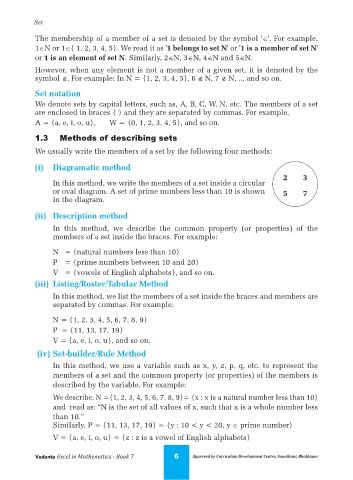
(i) Diagramatic method
2 3
In this method, we write the members of a set inside a circular
or oval diagram. A set of prime numbers less than 10 is shown 5 7
in the diagram.
(ii) Description method
In this method, we describe the common property (or properties) of the
members of a set inside the braces. For example:
N = {natural numbers less than 10}
P = {prime numbers between 10 and 20}
V = {vowels of English alphabets}, and so on.
(iii) Listing/Roster/Tabular Method
In this method, we list the members of a set inside the braces and members are
separated by commas. For example:
N = {1, 2, 3, 4, 5, 6, 7, 8, 9}
P = {11, 13, 17, 19}
V = {a, e, i, o, u}, and so on.
(iv) Set-builder/Rule Method
In this method, we use a variable such as x, y, z, p, q, etc. to represent the
members of a set and the common property (or properties) of the members is
described by the variable. For example:
We describe, N ={1, 2, 3, 4, 5, 6, 7, 8, 9}= {x : x is a natural number less than 10}
and read as: “N is the set of all values of x, such that x is a whole number less
than 10.”
Similarly, P = {11, 13, 17, 19} = {y : 10 < y < 20, y prime number}
V = {a, e, i, o, u} = {z : z is a vowel of English alphabets}
Vedanta Excel in Mathematics - Book 7 6 Approved by Curriculum Development Centre, Sanothimi, Bhaktapur

