


Page 12 - Math 7
P. 12
Set

           (i) Equal sets

                Let’s take any two sets, A = {s, v, u, 3, ª} and B = {ª, u, s, 3, v}.

                Here, n (A) = 5 and n (B) = 5. Thus, they have the equal cardinal number and
                both the sets have exactly the same elements. Therefore, sets A and B are said
                to be the equal sets and written as A = B.

                Thus, two or more than two sets are said to be equal if they have exactly the
                same elements and equal cardinal number.

           (ii) Equivalent sets
                Let’s take any two sets, A = { c, o, w } and B = { g, o, d}. Here,
                n (A) = 3 and n (B) = 3. They have the equal cardinal number.
                However, the elements c, w of set A are not contained by the set B and the
                elements g, d of the set B are not contained by the set A. So, they are not equal
                and they are said to be equivalent sets.
                We write it as A ~ B.
                Thus, two or more than two sets are said to be equivalent if they have the equal
                cardinal number but they do not have exactly the same elements.
           (iii) Overlapping sets

                Let’s take any two sets: A = {1, 2, 3, 6} and B = { 1, 2, 4, 8}.
                In these two sets, the elements 1 and 2 are common to both the sets. Therefore,
                sets A and B are overlapping sets.
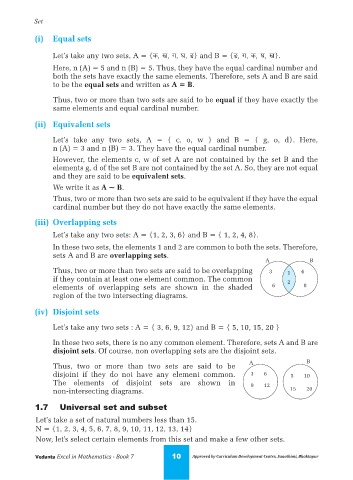
                                                                              A            B
                Thus, two or more than two sets are said to be overlapping     3     1   4
                if they contain at least one element common. The common              2
                elements of overlapping sets are shown in the shaded            6        8
                region of the two intersecting diagrams.

           (iv) Disjoint sets

                Let’s take any two sets : A = { 3, 6, 9, 12} and B = { 5, 10, 15, 20 }
                In these two sets, there is no any common element. Therefore, sets A and B are
                disjoint sets. Of course, non overlapping sets are the disjoint sets.

                Thus, two or more than two sets are said to be           A                B
                disjoint if they do not have any element common.          3   6      5   10
                The elements of disjoint sets are shown in                9   12
                non-intersecting diagrams.                                           15   20

           1.7    Universal set and subset
           Let’s take a set of natural numbers less than 15.
           N = {1, 2, 3, 4, 5, 6, 7, 8, 9, 10, 11, 12, 13, 14}
           Now, let's select certain elements from this set and make a few other sets.

           Vedanta Excel in Mathematics - Book 7   10    Approved by Curriculum Development Centre, Sanothimi, Bhaktapur

