


Page 13 - Math 7
P. 13
Set
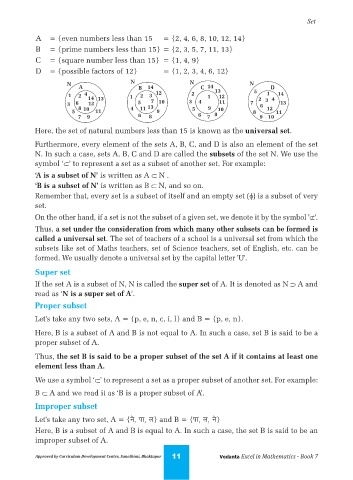
A = {even numbers less than 15 = {2, 4, 6, 8, 10, 12, 14}
B = {prime numbers less than 15} = {2, 3, 5, 7, 11, 13}
C = {square number less than 15} = {1, 4, 9}
D = {possible factors of 12} = {1, 2, 3, 4, 6, 12}
N A N B 14 N C 14 N D
1
1 2 4 14 13 1 2 3 12 2 1 13 12 5 2 3 4 14
3 6 12 5 13 7 10 3 4 11 7 6 13
5 8 10 11 4 11 9 5 9 8 10 8 12 11
7 9 6 8 6 7 910
Here, the set of natural numbers less than 15 is known as the universal set.
Furthermore, every element of the sets A, B, C, and D is also an element of the set
N. In such a case, sets A, B, C and D are called the subsets of the set N. We use the
symbol ‘’ to represent a set as a subset of another set. For example:
‘A is a subset of N’ is written as A N .
‘B is a subset of N’ is written as B N, and so on.
Remember that, every set is a subset of itself and an empty set (I) is a subset of very
set.
On the other hand, if a set is not the subset of a given set, we denote it by the symbol ''.
Thus, a set under the consideration from which many other subsets can be formed is
called a universal set. The set of teachers of a school is a universal set from which the
subsets like set of Maths teachers, set of Science teachers, set of English, etc. can be
formed. We usually denote a universal set by the capital letter 'U'.
Super set
If the set A is a subset of N, N is called the super set of A. It is denoted as N A and
read as ‘N is a super set of A’.
Proper subset
Let's take any two sets, A = {p, e, n, c, i, l} and B = {p, e, n}.
Here, B is a subset of A and B is not equal to A. In such a case, set B is said to be a
proper subset of A.
Thus, the set B is said to be a proper subset of the set A if it contains at least one
element less than A.
We use a symbol ‘’ to represent a set as a proper subset of another set. For example:
B A and we read it as ‘B is a proper subset of A’.
Improper subset
]
]
Let's take any two set, A = {g, kf, n} and B = {kf, n, g}
Here, B is a subset of A and B is equal to A. In such a case, the set B is said to be an
improper subset of A.
Approved by Curriculum Development Centre, Sanothimi, Bhaktapur 11 Vedanta Excel in Mathematics - Book 7

