


Page 113 - Health, Population and Environment Education 10
P. 113
6.1  introduction of natural Resources

            Those resources which are gifted by nature are called natural resources. We make the use
            of different types of natural resources in our daily life. We cannot survive without natural
            resources. For example, we use air for breathing, water for drinking, land for cultivation,
            construction, etc. Similarly, we use plants, trees, birds, animals, etc. for food. Without
            natural resources, life is not possible on the earth. They include both living and non-living
            things. In this chapter, we will be dealing with only living things present in nature.

            Concept of Biodiversity

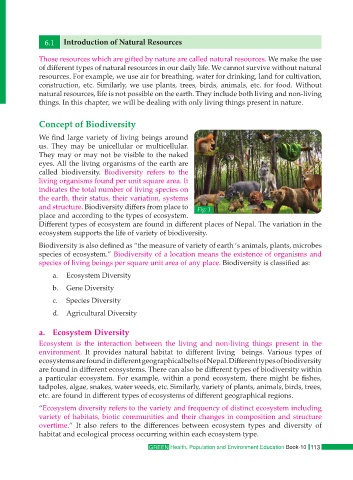
            We find large variety of living beings around
            us. They may be unicellular or multicellular.
            They may or may not be visible to the naked
            eyes. All the living organisms of the earth are
            called biodiversity.  Biodiversity refers to the
            living organisms found per unit square area. It
            indicates the total number of living species on
            the earth, their status, their variation, systems
            and structure. Biodiversity differs from place to   Fig: 1
            place and according to the types of ecosystem.
            Different types of ecosystem are found in different places of Nepal. The variation in the
            ecosystem supports the life of variety of biodiversity.

            Biodiversity is also defined as “the measure of variety of earth ‘s animals, plants, microbes
            species of ecosystem.” Biodiversity of a location means the existence of organisms and
            species of living beings per square unit area of any place. Biodiversity is classified as:
                a.  Ecosystem Diversity
                b.  Gene Diversity

                c.  Species Diversity
                d.  Agricultural Diversity

            a.  Ecosystem Diversity
            Ecosystem  is the interaction between the living and non-living things present in the
            environment.  It  provides  natural  habitat  to  different  living    beings.  Various  types  of
            ecosystems are found in different geographical belts of Nepal. Different types of biodiversity
            are found in different ecosystems. There can also be different types of biodiversity within
            a particular ecosystem. For example, within a pond ecosystem, there might be fishes,
            tadpoles, algae, snakes, water weeds, etc. Similarly, variety of plants, animals, birds, trees,
            etc. are found in different types of ecosystems of different geographical regions.
            “Ecosystem diversity refers to the variety and frequency of distinct ecosystem including
            variety of habitats, biotic communities and their changes in composition and structure
            overtime.”  It  also  refers  to  the  differences  between  ecosystem  types  and  diversity  of
            habitat and ecological process occurring within each ecosystem type.
                                            GREEN  Health, Population and Environment Education Book-10 113

