


Page 164 - Health, Population and Environment Education 10
P. 164
vi.  The rate of pulse and breathing increases.
          vii.  The patient may die in case of severe COPD if s/he does not get oxygen in time.

          Preventive and Control Measures
          i.   Smoking should be avoided.

          ii.  We should stay away from the allergy.
          iii.  The patient should stay in a clean environment having fresh air.
          iv.  Sufficient hot liquid should be taken.
          v.  Oxygen should be given immediately if there is difficulty in  breathing.

          vi.  Medicine should be taken according to doctor’s advice.
          vii.  Warm clothes should be worn to avoid cold.


           7.12  Environmentally infectious Diseases

          1.  Cholera
          Cholera is an infection of small intestine. It is caused by
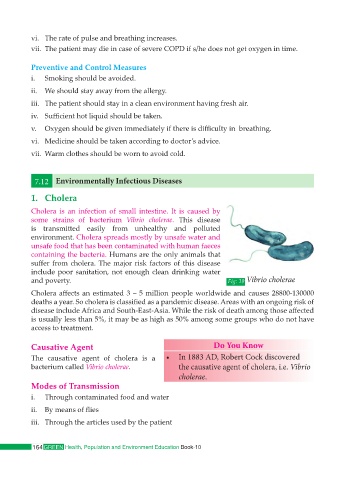
          some  strains  of  bacterium  Vibrio  cholerae. This  disease
          is  transmitted  easily  from  unhealthy  and  polluted
          environment. Cholera spreads mostly by unsafe water and
          unsafe food that has been contaminated with human faeces
          containing the bacteria. Humans are the only animals that
          suffer from cholera. The major risk factors of this disease
          include poor sanitation, not enough clean drinking water
          and poverty.                                             Fig: 19  Vibrio cholerae
          Cholera affects an estimated 3 – 5 million people worldwide and causes 28800-130000
          deaths a year. So cholera is classified as a pandemic disease. Areas with an ongoing risk of
          disease include Africa and South-East-Asia. While the risk of death among those affected
          is usually less than 5%, it may be as high as 50% among some groups who do not have
          access to treatment.


          Causative Agent                                      Do You Know
          The causative agent  of cholera is a   •  In 1883 AD, Robert Cock discovered
          bacterium called Vibrio cholerae.          the causative agent of cholera, i.e. Vibrio
                                                     cholerae.
          Modes of Transmission
          i.   Through contaminated food and water
          ii.  By means of flies

          iii.  Through the articles used by the patient


          164  GREEN Health, Population and Environment Education Book-10

