


Page 59 - Health, Population and Environment Education 10
P. 59
3.1  Population, Environment and Development Activities
            t
            The total number of people living in a particular place at a time is called population.
            Environment is the surrounding around us. Environment consists of biotic and abiotic
            components which are most essential for the proper growth, development and survival
            of people. People need various types of facilities like health, education, transportation,
            communication, electricity, etc. to make their life easier, comfortable, faster and improve
            the living standard. People get all of them from various development  activities. People
            develop infrastructures and facilities by utilizing various components in environment.
            When people conduct development works in a sustainable  way, environment can
            be  conserved  and  people  can  have  several  benefits  in  future.  Actually,  people  need
            development  activities.  Development  activities  require  resource  in  environment
            and environment needs people to conserve it. Hence,  population, environment and
            development activities are inter-related and  inter dependent on one another. Various
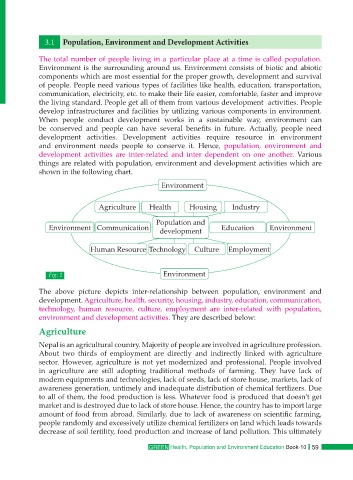
            things are related with population, environment and development activities which are
            shown in the following chart.

                                                Environment


                              Agriculture   Health      Housing      Industry
                                              Population and
               Environment Communication       development       Education     Environment


                           Human Resource Technology      Culture  Employment


               Fig: 1                           Environment

            The above picture depicts inter-relationship between population, environment and
            development. Agriculture, health, security, housing, industry, education, communication,
            technology, human resource,  culture, employment are inter-related with population,
            environment and development activities. They are described below:
            Agriculture

            Nepal is an agricultural country. Majority of people are involved in agriculture profession.
            About two thirds of employment are directly and indirectly linked with agriculture
            sector. However, agriculture is not yet modernized and professional. People involved
            in agriculture are still adopting traditional methods  of farming. They have lack of
            modern equipments and technologies, lack of seeds, lack of store house, markets, lack of
            awareness generation, untimely and inadequate distribution of chemical fertlizers. Due
            to all of them, the food production is less. Whatever food is produced that doesn’t get
            market and is destroyed due to lack of store house. Hence, the country has to import large
            amount of food from abroad. Similarly, due to lack of awareness on scientific farming,
            people randomly and excessively utilize chemical fertilizers on land which leads towards
            decrease of soil fertility, food production and increase of land pollution. This ultimately

                                            GREEN  Health, Population and Environment Education Book-10 59

