


Page 63 - Health, Population and Environment Education 10
P. 63
3.2  Regional Balance in Development
            Development includes increase of infrastructures availability of facilities, creation of job
            opportunities, improvement of living standard. Actually, development activities should
            be conducted in all the parts of nation in a balanced way. The minimum requirement
            of basic needs of people should be fulfilled in the local level. But, Nepal has a lot more
            geographical  diversities  and  development  activities  are  not  equally  conducted  in  all
            parts of Nepal. Different regions are not equally developed. Kathmandu valley and some
            other cities in Nepal are more developed than other parts of Nepal. The mid western
            development region and far western development region are quite backward. The entire
            karnali  region is backward. The facilities like health, education, security, transportation,
            communication, employment, etc. are more centered on major cities including Kathmandu
            valley. Hence, it is most essential to have regional balance.

            Regional balance implies uniform distribution pattern of the planned investment among
            different regions of a country.

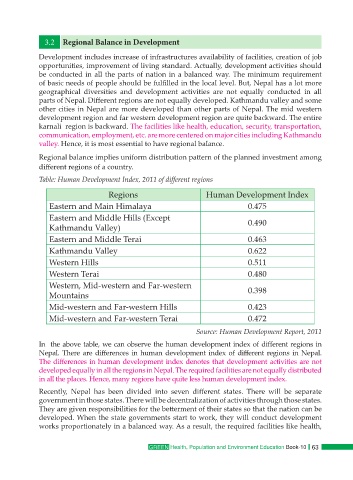
            Table: Human Development Index, 2011 of different regions
                                 Regions                     Human Development Index
               Eastern and Main Himalaya                                 0.475
               Eastern and Middle Hills (Except                          0.490
               Kathmandu Valley)
               Eastern and Middle Terai                                  0.463
               Kathmandu Valley                                          0.622
               Western Hills                                             0.511

               Western Terai                                             0.480
               Western, Mid-western and Far-western                      0.398
               Mountains

               Mid-western and Far-western Hills                         0.423
               Mid-western and Far-western Terai                         0.472
                                                          Source: Human Development Report, 2011

            In  the above table, we can observe the human development index of different regions in
            Nepal. There are differences in human development index of different regions in Nepal.
            The differences in human development index denotes that development activities are not
            developed equally in all the regions in Nepal. The required facilities are not equally distributed
            in all the places. Hence, many regions have quite less human development index.
            Recently,  Nepal  has  been  divided  into  seven  different  states.  There  will  be  separate
            government in those states. There will be decentralization of activities through those states.
            They are given responsibilities for the betterment of their states so that the nation can be
            developed. When the state governments start to work, they will conduct development
            works proportionately in a balanced way. As a result, the required facilities like health,


                                            GREEN  Health, Population and Environment Education Book-10 63

