


Page 67 - Health, Population and Environment Education 10
P. 67
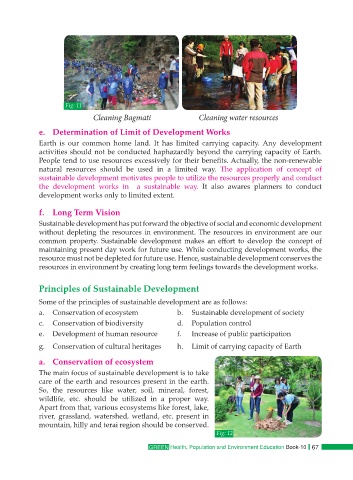
Fig: 11
                            Cleaning Bagmati               Cleaning water resources

            e.  Determination of Limit of Development Works
            Earth is  our  common  home  land.  It has  limited  carrying capacity.  Any development
            activities should not be conducted haphazardly beyond the carrying capacity of Earth.
            People tend to use resources excessively for their benefits. Actually, the non-renewable
            natural resources should be used in a limited way.  The application of concept of
            sustainable development motivates people to utilize the resources properly and conduct
            the development works in  a sustainable way. It also awares planners to conduct
            development works only to limited extent.


            f.  Long Term Vision
            Sustainable development has put forward the objective of social and economic development
            without depleting the resources in environment. The resources in environment are our
            common  property.  Sustainable  development  makes  an  effort  to  develop  the  concept  of
            maintaining present day work for future use. While conducting development works, the
            resource must not be depleted for future use. Hence, sustainable development conserves the
            resources in environment by creating long term feelings towards the development works.

            Principles of Sustainable Development

            Some of the principles of sustainable development are as follows:
            a.  Conservation of ecosystem            b.  Sustainable development of society
            c.  Conservation of biodiversity         d.  Population control
            e.  Development of human resource        f.   Increase of public participation
            g.  Conservation of cultural heritages   h.  Limit of carrying capacity of Earth

            a.  Conservation of ecosystem
            The main focus of sustainable development is to take
            care of the earth and resources present in the earth.
            So, the resources like water, soil, mineral, forest,
            wildlife, etc. should be utilized in a proper way.
            Apart from that, various ecosystems like forest, lake,
            river, grassland, watershed, wetland, etc. present in
            mountain, hilly and terai region should be conserved.
                                                                Fig: 12
                                            GREEN  Health, Population and Environment Education Book-10 67

