


Page 28 - Math 4
P. 28
Whole Numbers                                                                                                                                                                   Whole Numbers

            Unit                              Whole Numbers
              2


          2.1 Natural numbers - The counting numbers

               Let's have some discussions on these questions.
               a)  How do you count the number of fingers of your hands?

               b)   How do you count the number of students of your class?
               c)  How do you count your pocket money?
                We count the number of objects by one (1), two (2), three (3), four (4), five
               (5), ... Therefore, 1, 2, 3, 4, 5, ... are the counting numbers. These counting
               numbers are the natural numbers.
          2.2 Whole numbers


               Again, let's have some discussions on these questions.
               a)  You had a sweet and you gave it to your sister. How many sweets were
                   left with you?
               b)   How much is left when 5 is subtracted from 5?
               c)  How many oceans are there in Nepal?

                   The answer of each of these questions is 'None'
                In  counting,  none  means  zero  (0).  So,  zero  also  counts  the  number  of
               objects. However, it counts 'there is no any number of objects'.
               In this way, counting numbers include zero (0) as well. The natural numbers
               including  zero  are  the  whole  numbers.  0,  1,  2,  3,  4,  5,  ...  are  the  whole
               numbers.
                                        Classwork - Exercise

          1.  Let's tell and write the answer as quickly as possible.


               a)  Natural number less than 6 are

               b)  Whole numbers less than 6 are
               c)  Is 0 a natural number?
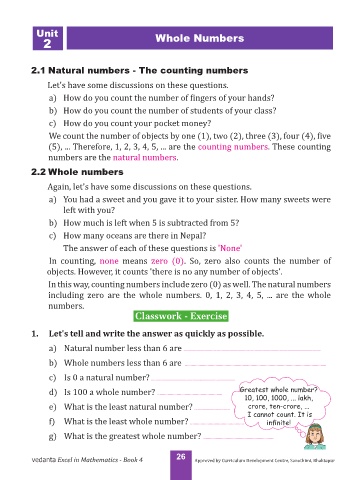
                                                                       Greatest whole number?
               d)  Is 100 a whole number?
                                                                        10, 100, 1000, ... lakh,
                                                                         crore, ten-crore, ...
               e)  What is the least natural number?
                                                                          I cannot count. It is
               f)  What is the least whole number?                             infinite!

               g)  What is the greatest whole number?

                                                    26
          v
          vedanta Excel in Mathematics - Book 4     26    Approved by Curriculum Development Centre, Sanothimi, Bhaktapur
                    c
                  Ex
                     e
           edanta
                      l in Mathematics - Book 4

