


Page 29 - Math 4
P. 29
Whole Numbers                                                                      Whole Numbers


               h)  Are all natural numbers whole numbers?

               i)  Are all whole numbers natural numbers?

          2.3 Odd and even numbers


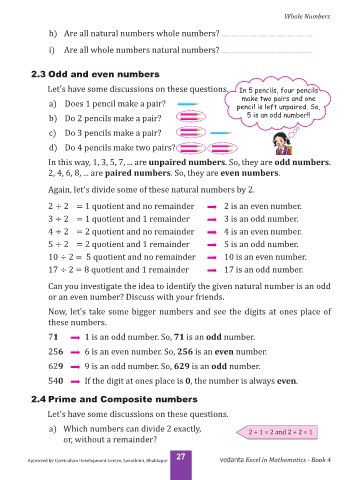
               Let's have some discussions on these questions.         In 5 pencils, four pencils
                                                                       make two pairs and one
               a)  Does 1 pencil make a pair?                         pencil is left unpaired. So,
                                                                         5 is an odd number!!
               b)   Do 2 pencils make a pair?

               c)  Do 3 pencils make a pair?
               d)  Do 4 pencils make two pairs?

               In this way, 1, 3, 5, 7, ... are unpaired numbers. So, they are odd numbers.
               2, 4, 6, 8, ... are paired numbers. So, they are even numbers.

               Again, let's divide some of these natural numbers by 2.

               2 ÷ 2   = 1 quotient and no remainder              2 is an even number.
               3 ÷ 2   = 1 quotient and 1 remainder               3 is an odd number.

               4 ÷ 2   = 2 quotient and no remainder              4 is an even number.
               5 ÷ 2   = 2 quotient and 1 remainder               5 is an odd number.
               10 ÷ 2 =  5 quotient and no remainder              10 is an even number.

               17 ÷ 2 = 8 quotient and 1 remainder                17 is an odd number.

               Can you investigate the idea to identify the given natural number is an odd
               or an even number? Discuss with your friends.
               Now, let's take some bigger numbers and see the digits at ones place of
               these numbers.

               71         1 is an odd number. So, 71 is an odd number.

               256        6 is an even number. So, 256 is an even number.
               629        9 is an odd number. So, 629 is an odd number.

               540        If the digit at ones place is 0, the number is always even.
          2.4 Prime and Composite numbers


               Let's have some discussions on these questions.

               a)  Which numbers can divide 2 exactly,
                                                                         2 ÷ 1 = 2 and 2 ÷ 2 = 1
                   or, without a remainder?
                                                    27
                                                    27
                                                                            l in Mathematics - Book 4
                                                                           c
                                                                           e
                                                                  edanta
                                                                 v
                                                                         Ex
         Approved by Curriculum Development Centre, Sanothimi, Bhaktapur  vedanta Excel in Mathematics - Book 4

