


Page 30 - Math 4
P. 30
Whole Numbers                                                                                                                                                                   Whole Numbers


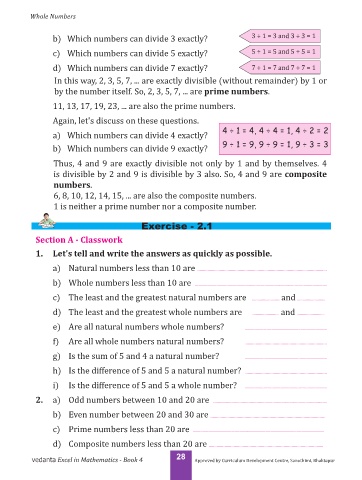
                                                                          3 ÷ 1 = 3 and 3 ÷ 3 = 1
                b)   Which numbers can divide 3 exactly?
                c)  Which numbers can divide 5 exactly?                   5 ÷ 1 = 5 and 5 ÷ 5 = 1

                d)  Which numbers can divide 7 exactly?                   7 ÷ 1 = 7 and 7 ÷ 7 = 1
                 In this way, 2, 3, 5, 7, ... are exactly divisible (without remainder) by 1 or
                 by the number itself. So, 2, 3, 5, 7, ... are prime numbers.

                11, 13, 17, 19, 23, ... are also the prime numbers.

                Again, let's discuss on these questions.
                                                                  4 ÷ 1 = 4, 4 ÷ 4 = 1, 4 ÷ 2 = 2
                a)  Which numbers can divide 4 exactly?
                                                                  9 ÷ 1 = 9, 9 ÷ 9 = 1, 9 ÷ 3 = 3
                b)  Which numbers can divide 9 exactly?
                 Thus, 4 and 9 are exactly divisible not only by 1 and by themselves. 4
                 is divisible by 2 and 9 is divisible by 3 also. So, 4 and 9 are composite

                 numbers.
                 6, 8, 10, 12, 14, 15, ... are also the composite numbers.
                 1 is neither a prime number nor a composite number.

                                          Exercise - 2.1
           Section A - Classwork

           1.  Let's tell and write the answers as quickly as possible.

                a)  Natural numbers less than 10 are

                b)  Whole numbers less than 10 are

                c)  The least and the greatest natural numbers are                 and
                d)  The least and the greatest whole numbers are                   and

                e)  Are all natural numbers whole numbers?

                f)  Are all whole numbers natural numbers?
                g)  Is the sum of 5 and 4 a natural number?

                h)  Is the difference of 5 and 5 a natural number?

                i)  Is the difference of 5 and 5 a whole number?
           2.  a)  Odd numbers between 10 and 20 are

                b)  Even number between 20 and 30 are

                c)  Prime numbers less than 20 are
                d)  Composite numbers less than 20 are
                                                    28
          v edanta  Ex c e l in Mathematics - Book 4  28  Approved by Curriculum Development Centre, Sanothimi, Bhaktapur
          vedanta Excel in Mathematics - Book 4

