


Page 152 - leadership-experience-2008
P. 152
CikguOnline
         CikguOnline
               CHAPTER 5: LEADERSHIP MIND AND HEART                                                      133
                   Developing leadership capacity goes beyond learning the skills for organiz-
               ing, planning, or controlling others. It also involves something deeper and more
               subtle than the leadership traits and styles we discussed in Chapters 2 and 3.
               Living, working, and leading based on our capacity means using our whole
               selves, including intellectual, emotional, and spiritual abilities and understand-
               ings. A broad literature has emphasized that being a whole person means op-
                                                     7
               erating from mind, heart, spirit, and body.  Although we can’t “learn” capacity
               the way we learn a set of skills, we can expand and develop leadership capacity.
               Just as the physical capacity of our lungs is increased through regular aerobic
               exercise, the capacities of the mind, heart, and spirit can be expanded through
               conscious development and regular use. In the previous chapter, we introduced
               some ideas about how individuals think, make decisions, and solve problems
               based on values, attitudes, and patterns of thinking. This chapter builds on some
               of those ideas to provide a broader view of the leadership capacities of mind
               and heart.


               Mental Models

               A mental model can be thought of as an internal picture that affects a leader’s ac-
               tions and relationships with others. Mental models are theories people hold about   Mental models
                                                                                        Mental models
                                                                                        theories people hold about
                                                                  8
               specifi c systems in the world and their expected behavior.  A system means any   theories people hold about
                                                                                        specifi c systems in the world and
               set of elements that interact to form a whole and produce a specifi ed outcome.   specifi  c systems in the world and
                                                                                        their expected behavior
                                                                                        their expected behavior

               An organization is a system, as is a football team, a sorority pledge drive, a
               marriage, the registration system at a university, or the claims process at an in-
               surance company. Leaders have many mental models that tend to govern how
               they interpret experiences and how they act in response to people and situa-
               tions. For example, one mental model about what makes an effective team is that
               members share a sense of team ownership and feel that they have authority and
                                                       9
               responsibility for team actions and outcomes.  A leader with this mental model
               would likely push power, authority, and decision making down to the team
               level and strive to build norms that create a strong group iden-
                                                                             As a leader, you can become aware of your
               tity and trust among members. However, a leader with a mental
               model that every group needs a strong leader to take control and   Action Memo
               make the decisions is less likely to encourage norms that lead   mental models and how they affect your
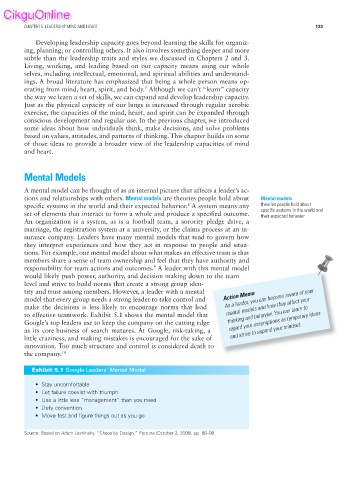
               to effective teamwork. Exhibit 5.1 shows the mental model that   thinking and behavior. You can learn to
               Google’s top leaders use to keep the company on the cutting edge   regard your assumptions as temporary ideas
               as its core business of search matures. At Google, risk-taking, a   and strive to expand your mindset.
               little craziness, and making mistakes is encouraged for the sake of
               innovation. Too much structure and control is considered death to
               the company. 10


                  Exhibit 5.1 Google Leaders’ Mental Model
                   •  Stay uncomfortable
                    •  Let failure coexist with triumph
                    •  Use a little less “management” than you need
                   •  Defy convention
                    •  Move fast and figure things out as you go


               Source: Based on Adam Lashinsky, “Chaos by Design,” Fortune (October 2, 2006), pp. 86–98.

