


Page 228 - leadership-experience-2008
P. 228
CikguOnline
         CikguOnline
               CHAPTER 7: FOLLOWERSHIP                                                                   209
                   Similarly, effective followers present realistic images of themselves. Followers
               do not try to hide their weaknesses or cover their mistakes, nor do they criticize
                                  46
               their leaders to others.  Hiding things is symptomatic of conforming and passive
               followers. Criticizing leaders to others merely bolsters alienation and reinforces the
               mindset of an alienated follower. These kinds of alienated and passive behaviors can
               have negative—and sometimes disastrous—consequences for leaders, followers, and
               the organization, as illustrated by the stories in this chapter’s Leader’s Bookshelf.
               Only positive things about a leader should be shared with others. It is an alienated
               follower who complains without engaging in constructive action. Instead of criticiz-
               ing a leader to others, it is far more constructive to directly disagree with a leader on
               matters relevant to the department’s or organization’s work.


               What Followers Want
               Throughout much of this chapter, we’ve been talking about demands on follow-
               ers and how followers can become more effective and powerful in the organiza-
               tion. However, the full responsibility doesn’t fall on the follower. To have good
               followers, the requirements and obligations of those in a leadership role should
                                   47
               be reexamined as well.  Leaders have a duty to create a leader–follower relation-
               ship that engages whole people rather than treats followers as passive sheep who
               should blindly follow orders and support the boss.
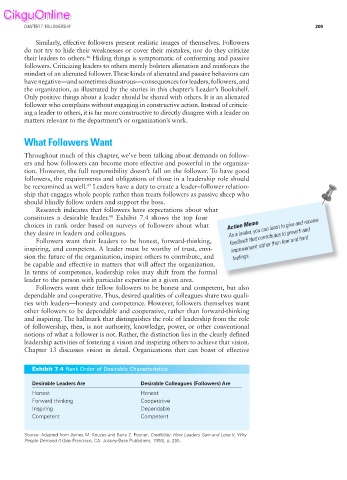
                   Research indicates that followers have expectations about what
                                         48
               constitutes a desirable leader.  Exhibit 7.4 shows the top four
                                                                              As a leader, you can learn to give and receive
               choices in rank order based on surveys of followers about what   Action Memo
               they desire in leaders and colleagues.                          feedback that contributes to growth and
                   Followers want their leaders to be honest, forward-thinking,   improvement rather than fear and hard
               inspiring, and competent. A leader must be worthy of trust, envi-
               sion the future of the organization, inspire others to contribute, and   feelings.
               be capable and effective in matters that will affect the organization.
               In terms of competence, leadership roles may shift from the formal
               leader to the person with particular expertise in a given area.
                   Followers want their fellow followers to be honest and competent, but also
               dependable and cooperative. Thus, desired qualities of colleagues share two quali-
               ties with leaders—honesty and competence. However, followers themselves want
               other followers to be dependable and cooperative, rather than forward-thinking
               and  inspiring. The hallmark that distinguishes the role of leadership from the role
               of  followership, then, is not authority, knowledge, power, or other conventional
               notions of what a follower is not. Rather, the distinction lies in the clearly  defi ned
               leadership activities of fostering a vision and inspiring others to achieve that  vision.
               Chapter 13 discusses vision in detail. Organizations that can boast of effective


                  Exhibit 7.4 Rank Order of Desirable Characteristics
                  Desirable Leaders Are            Desirable Colleagues (Followers) Are
                  Honest                           Honest
                  Forward thinking                 Cooperative
                  Inspiring                        Dependable
                  Competent                        Competent

               Source: Adapted from James M. Kouzes and Barry Z. Posner, Credibility: How Leaders Gain and Lose It, Why
               People Demand It (San Francisco, CA: Jossey-Bass Publishers, 1993), p. 255.

