


Page 379 - leadership-experience-2008
P. 379
CikguOnline
      CikguOnline
            360                                                               PART 4: THE LEADER AS A RELATIONSHIP BUILDER
                                       Used wisely and ethically, charisma can lift the entire organization’s level of
                                   performance. Charismatic leaders can raise people’s consciousness about new
                                   possibilities and motivate them to transcend their own interests for the sake of
                                   the team, department, or organization.
                                       Although charisma itself cannot be learned, there are aspects of charis-
                                   matic leadership that anyone can use. For one thing, charisma comes from
                                   pursuing activities that you have a true passion for, such as Bill Strickland
                                   in the opening example. Charismatic leaders are engaging their emotions in
                                   everyday work life, which makes them energetic, enthusiastic, and attractive
                                   to others. Their passion galvanizes people to action. Consider Major Tony
                                   Burgess, the U.S. Army tactical offi cer attached on a full-time basis to Com-
                                   pany C-2 at West Point. Burgess planned to get out of the Army after fi ve years
                                   and become a millionaire businessman. “Then, somewhere along the way,”
                                   he says, “I fell in love with leading.” To Burgess, there’s no better job in the
                                    world than commanding an Army company. He is so passionate about his
                                               work that he started his own Web site, CompanyCommand.com,
             Action Memo
                                               a resource for company commanders, and has written a book on
                                              the topic. 16
             As a leader, you can use aspects of
            charismatic leadership by articulating
                                              What Makes a Charismatic Leader?
            a vision, making personal sacrifi  ces to
                                             Understanding charismatic leadership qualities and behavior can help
            help achieve it, and appealing to people’s
                                             anyone become a stronger leader. A number of studies have identifi ed
           emotions more than to their minds. Expand
                                            the unique qualities of charismatic leaders, documented the impact
           your charismatic potential by pursuing
                                            they have on followers, and described the behaviors that help them
          activities that you genuinely love.
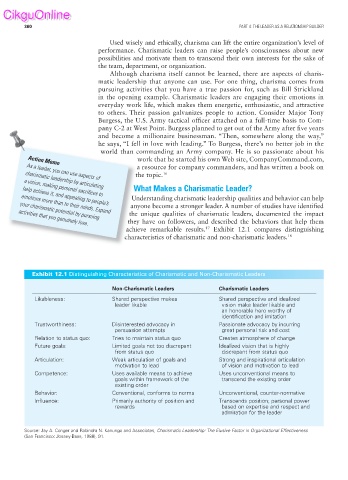
                                           achieve remarkable results.  Exhibit 12.1 compares distinguishing
                                                                    17
                                           characteristics of charismatic and non-charismatic leaders. 18


               Exhibit 12.1 Distinguishing Characteristics of Charismatic and Non-Charismatic Leaders

                                       Non-Charismatic Leaders          Charismatic Leaders
               Likableness:            Shared perspective makes         Shared perspective and idealized
                                        leader likable                    vision make leader likable and
                                                                          an honorable hero worthy of
                                                                          identification and imitation
               Trustworthiness:        Disinterested advocacy in        Passionate advocacy by incurring
                                        persuasion attempts               great personal risk and cost
               Relation to status quo:  Tries to maintain status quo    Creates atmosphere of change
               Future goals:           Limited goals not too discrepant   Idealized vision that is highly
                                         from status quo                  discrepant from status quo
               Articulation:           Weak articulation of goals and   Strong and inspirational articulation
                                         motivation to lead               of vision and motivation to lead
               Competence:             Uses available means to achieve   Uses unconventional means to
                                         goals within framework of the     transcend the existing order
                                        existing order
               Behavior:               Conventional, conforms to norms  Unconventional, counter-normative
               Influence:              Primarily authority of position and   Transcends position; personal power
                                        rewards                           based on expertise and respect and
                                                                          admiration for the leader


            Source: Jay A. Conger and Rabindra N. Kanungo and Associates, Charismatic Leadership: The Elusive Factor in Organizational Effectiveness
            (San Francisco: Jossey-Bass, 1988), 91.

