


Page 382 - leadership-experience-2008
P. 382
CikguOnline
         CikguOnline
               CHAPTER 12: LEADERSHIP POWER AND INFLUENCE                                                363
                 situations. As we learned in Chapter 7 on followership, followers may also in-

               fluence a leader’s behavior in any number of ways, for better or worse. Later in
               this chapter, we will examine some specifi c infl uence tactics that may be used to
               change another’s attitudes or behavior. Leaders can improve their effectiveness
               by understanding the various types and sources of power as well as the infl uence
               tactics they or their followers may use.
               Five Types of Leader Power
               Power is often described as a personal characteristic, but as described above, or-

               ganizational position also influences a leader’s power. Most discussions of power
               include fi ve types that are available to leaders. 29

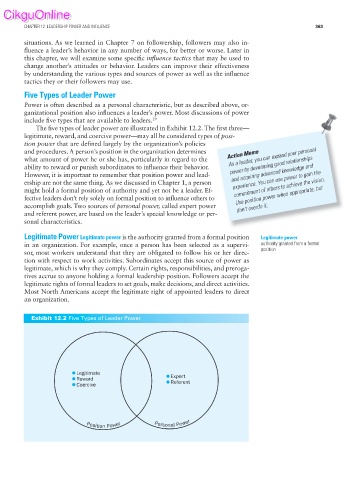
                   The five types of leader power are illustrated in Exhibit 12.2. The fi rst three—
               legitimate, reward, and coercive power—may all be considered types of posi-
               tion power that are defined largely by the organization’s policies

               and procedures. A person’s position in the organization determines   Action Memo
               what amount of power he or she has, particularly in regard to the   As a leader, you can expand your personal
               ability to reward or punish subordinates to infl uence their behavior.   power by developing good relationships
               However, it is important to remember that position power and lead-  and acquiring advanced knowledge and
               ership are not the same thing. As we discussed in Chapter 1, a person   experience. You can use power to gain the
               might hold a formal position of authority and yet not be a leader. Ef-  commitment of others to achieve the vision.
               fective leaders don’t rely solely on formal position to infl uence others to   Use position power when appropriate, but
               accomplish goals. Two sources of personal power, called expert power   don’t overdo it.
               and referent power, are based on the leader’s special knowledge or per-
               sonal characteristics.

               Legitimate Power Legitimate power is the authority granted from a formal position   Legitimate power
                                                                                        Legitimate power
                                                                                        authority granted from a formal
               in an organization. For example, once a person has been selected as a supervi-  authority granted from a formal
                                                                                        position
               sor, most workers understand that they are obligated to follow his or her direc-  position
               tion with respect to work activities. Subordinates accept this source of power as
                 legitimate, which is why they comply. Certain rights, responsibilities, and preroga-
               tives accrue to anyone holding a formal leadership position. Followers accept the
                 legitimate rights of formal leaders to set goals, make decisions, and direct activities.
               Most North Americans accept the legitimate right of appointed leaders to direct
               an organization.


                  Exhibit 12.2 Five Types of Leader Power


                              • Legitimate
                              • Reward                     • Expert
                              • Coercive                   • Referent


                                   Position Power       Personal Power

