


Page 454 - leadership-experience-2008
P. 454
CikguOnline
         CikguOnline
               CHAPTER 14: SHAPING CULTURE AND VALUES                                                    435

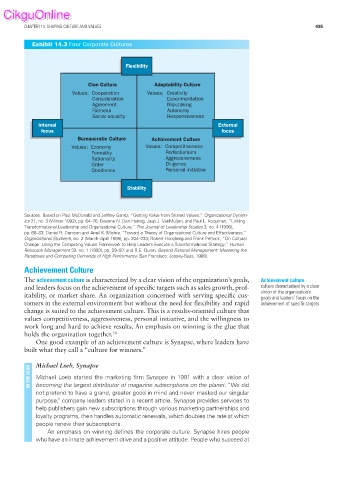
                  Exhibit 14.3 Four Corporate Cultures


                                               Flexibility


                                   Clan Culture         Adaptability Culture
                              Values:  Cooperation   Values:  Creativity
                                    Consideration          Experimentation
                                    Agreement              Risk-taking
                                    Fairness               Autonomy
                                    Social equality        Responsiveness
                    Internal                                               External
                     focus                                                  focus
                                Bureaucratic Culture   Achievement Culture
                              Values:  Economy       Values:  Competitiveness
                                    Formality              Perfectionism
                                    Rationality            Aggressiveness
                                    Order                  Diligence
                                    Obedience              Personal initiative


                                               Stability


               Sources: Based on Paul McDonald and Jeffrey Gandz, “Getting Value from Shared Values,” Organizational Dynam-
               ics 21, no. 3 (Winter 1992), pp. 64–76; Deanne N. Den Hartog, Jaap J. VanMuijen, and Paul L. Koopman, “Linking
               Transformational Leadership and Organizational Culture,” The Journal of Leadership Studies 3, no. 4 (1996),
               pp. 68–83; Daniel R. Denison and Aneil K. Mishra, “Toward a Theory of Organizational Culture and Effectiveness,”
               Organizational Studies 6, no. 2 (March–April 1995), pp. 204–223; Robert Hooijberg and Frank Petrock, “On Cultural
               Change: Using the Competing Values Framework to Help Leaders Execute a Transformational Strategy,” Human
               Resource Management 32, no. 1 (1993), pp. 29–50; and R.E. Quinn, Beyond Rational Management: Mastering the
               Paradoxes and Competing Demands of High Performance (San Francisco: Jossey-Bass, 1998).
               Achievement Culture
               The achievement culture is characterized by a clear vision of the organization’s goals,   Achievement culture
                                                                                        Achievement culture
                                                                                        culture characterized by a clear
               and leaders focus on the achievement of specific targets such as sales growth, prof-  culture characterized by a clear

                                                                                                       s
                                                                                        vision of the organization’
               itability, or market share. An organization concerned with serving specifi c cus-  vision of the organization’s
                                                                                        goals and leaders’ focus on the
                                                                                        goals and leaders’ focus on the
               tomers in the external environment but without the need for fl exibility and rapid   achievement of specifi  c targets
                                                                                        achievement of specifi c targets
               change is suited to the achievement culture. This is a results-oriented culture that
               values competitiveness, aggressiveness, personal initiative, and the willingness to
               work long and hard to achieve results. An emphasis on winning is the glue that
               holds the organization together. 50
                   One good example of an achievement culture is Synapse, where leaders have
               built what they call a “culture for winners.”
                   Michael Loeb, Synapse
                 IN THE LEAD  Michael Loeb started the marketing fi rm Synapse in 1991 with a clear vision of
                   becoming the largest distributor of magazine subscriptions on the planet. “We did
                   not pretend to have a grand, greater good in mind and never masked our singular
                   purpose,” company leaders stated in a recent article. Synapse provides services to
                   help publishers gain new subscriptions through various marketing partnerships and
                   loyalty programs, then handles automatic renewals, which doubles the rate at which
                   people renew their subscriptions.
                      An emphasis on winning defines the corporate culture. Synapse hires people

                   who have an innate achievement drive and a positive attitude. People who succeed at

