


Page 463 - leadership-experience-2008
P. 463
CikguOnline
      CikguOnline
            444                                                                   PART 5: THE LEADER AS SOCIAL ARCHITECT

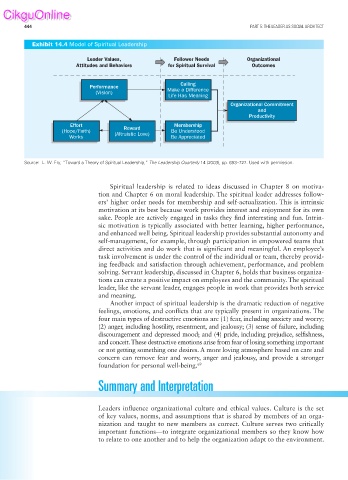
               Exhibit 14.4 Model of Spiritual Leadership

                                Leader Values,            Follower Needs         Organizational
                            Attitudes and Behaviors      for Spiritual Survival   Outcomes


                                                            Calling
                                Performance
                                  (Vision)              Make a Difference
                                                         Life Has Meaning
                                                                            Organizational Commitment
                                                                                    and
                                                                                 Productivity
                          Effort           Reward         Membership
                        (Hope/Faith)    (Altruistic Love)  Be Understood
                          Works                          Be Appreciated


            Source:  L. W. Fry, “Toward a Theory of Spiritual Leadership,” The Leadership Quarterly 14 (2003), pp. 693–727. Used with permission.


                                       Spiritual leadership is related to ideas discussed in Chapter 8 on motiva-
                                   tion and Chapter 6 on moral leadership. The spiritual leader addresses follow-
                                   ers’ higher order needs for membership and self-actualization. This is intrinsic
                                   motivation at its best because work provides interest and enjoyment for its own
                                   sake. People are actively engaged in tasks they fi nd interesting and fun. Intrin-
                                   sic motivation is typically associated with better learning, higher performance,
                                   and enhanced well being. Spiritual leadership provides substantial autonomy and
                                   self-management, for example, through participation in empowered teams that
                                   direct activities and do work that is signifi cant and meaningful. An employee’s
                                   task involvement is under the control of the individual or team, thereby provid-
                                   ing feedback and satisfaction through achievement, performance, and problem
                                   solving. Servant leadership, discussed in Chapter 6, holds that business organiza-
                                   tions can create a positive impact on employees and the community. The spiritual
                                   leader, like the servant leader, engages people in work that provides both service
                                   and meaning.
                                       Another impact of spiritual leadership is the dramatic reduction of negative
                                   feelings, emotions, and conflicts that are typically present in organizations. The

                                   four main types of destructive emotions are (1) fear, including anxiety and worry;
                                   (2) anger, including hostility, resentment, and jealousy; (3) sense of failure, including
                                   discouragement and depressed mood; and (4) pride, including prejudice, selfi shness,
                                   and conceit. These destructive emotions arise from fear of losing something important
                                   or not getting something one desires. A more loving atmosphere based on care and
                                   concern can remove fear and worry, anger and jealousy, and provide a stronger
                                   foundation for personal well-being. 69

                                   Summary and Interpretation


                                   Leaders infl uence organizational culture and ethical values. Culture is the set
                                   of key values, norms, and assumptions that is shared by members of an orga-
                                   nization and taught to new members as correct. Culture serves two critically
                                   important functions—to integrate organizational members so they know how
                                   to relate to one another and to help the organization adapt to the environment.

