


Page 60 - leadership-experience-2008
P. 60
CikguOnline
         CikguOnline
               CHAPTER 2: TRAITS, BEHAVIORS, AND RELATIONSHIPS                                            41

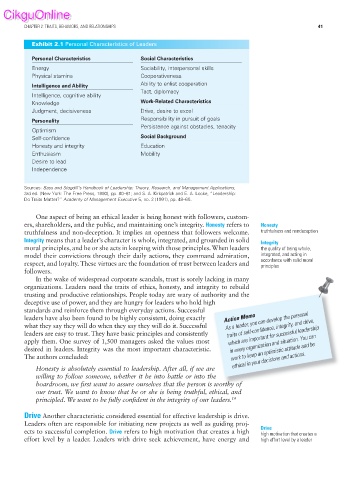
                  Exhibit 2.1 Personal Characteristics of Leaders

                  Personal Characteristics         Social Characteristics
                  Energy                           Sociability, interpersonal skills
                  Physical stamina                 Cooperativeness
                  Intelligence and Ability         Ability to enlist cooperation
                                                   Tact, diplomacy
                  Intelligence, cognitive ability
                  Knowledge                        Work-Related Characteristics
                  Judgment, decisiveness           Drive, desire to excel
                  Personality                      Responsibility in pursuit of goals
                                                   Persistence against obstacles, tenacity
                  Optimism
                  Self-confidence                  Social Background
                  Honesty and integrity            Education
                  Enthusiasm                       Mobility
                  Desire to lead
                  Independence


               Sources: Bass and Stogdill’s Handbook of Leadership: Theory, Research, and Management Applications,
               3rd ed. (New York: The Free Press, 1990), pp. 80–81; and S. A. Kirkpatrick and E. A. Locke, “Leadership:
               Do Traits Matter?” Academy of Management Executive 5, no. 2 (1991), pp. 48–60.

                   One aspect of being an ethical leader is being honest with followers, custom-
               ers, shareholders, and the public, and maintaining one’s integrity. Honesty refers to   Honesty
                                                                                        Honesty
                                                                                        truthfulness and nondeception
               truthfulness and non-deception. It implies an openness that followers welcome.   truthfulness and nondeception
               Integrity means that a leader’s character is whole, integrated, and grounded in solid
                                                                                        Integrity
                                                                                        Integrity
               moral principles, and he or she acts in keeping with those principles. When leaders   the quality of being whole,
                                                                                        the quality of being whole,
                                                                                        integrated, and acting in
               model their convictions through their daily actions, they command admiration,   integrated, and acting in
                                                                                        accordance with solid moral
                                                                                        accordance with solid moral
               respect, and loyalty. These virtues are the foundation of trust between leaders and
                                                                                        principles
                                                                                        principles
               followers.
                   In the wake of widespread corporate scandals, trust is sorely lacking in many
               organizations. Leaders need the traits of ethics, honesty, and integrity to rebuild
               trusting and productive relationships. People today are wary of authority and the
               deceptive use of power, and they are hungry for leaders who hold high
               standards and reinforce them through everyday actions. Successful
                                                                              As a leader, you can develop the personal
               leaders have also been found to be highly consistent, doing exactly   Action Memo
               what they say they will do when they say they will do it. Successful   traits of self-confi  dence, integrity, and drive,
               leaders are easy to trust. They have basic principles and consistently   which are important for successful leadership
               apply them. One survey of 1,500 managers asked the values most   in every organization and situation. You can
               desired in leaders. Integrity was the most important characteristic.   work to keep an optimistic attitude and be
               The authors concluded:                                           ethical in your decisions and actions.
                   Honesty is absolutely essential to leadership. After all, if we are
                   willing to follow someone, whether it be into battle or into the
                   boardroom, we first want to assure ourselves that the person is worthy of

                   our trust. We want to know that he or she is being truthful, ethical, and
                   principled. We want to be fully confi dent in the integrity of our leaders. 14
               Drive Another characteristic considered essential for effective leadership is drive.
               Leaders often are responsible for initiating new projects as well as guiding proj-
                                                                                        Drive
                                                                                        Drive
               ects to successful completion. Drive refers to high motivation that creates a high
                                                                                        high motivation that creates a
                                                                                        high motivation that creates a
               effort level by a leader. Leaders with drive seek achievement, have energy and   high effort level by a leader
                                                                                        high effort level by a leader

