


Page 61 - leadership-experience-2008
P. 61
CikguOnline
      CikguOnline
                                        Getty Images           Leader’s Self-Insight 2.1


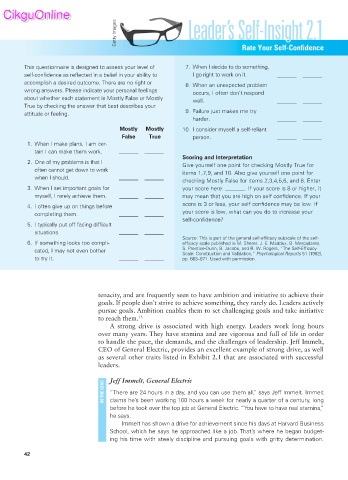
            This questionnaire is designed to assess your level of   7. When I decide to do something,
            self-confidence as reflected in a belief in your ability to   I go right to work on it.  _______ _______
            accomplish a desired outcome. There are no right or
                                                              8. When an unexpected problem
            wrong answers. Please indicate your personal feelings
                                                                occurs, I often don’t respond
            about whether each statement is Mostly False or Mostly
                                                                well.                     _______ _______
            True by checking the answer that best describes your
                                                              9. Failure just makes me try
            attitude or feeling.
                                                                harder.                   _______ _______
                                          Mostly   Mostly    10.  I consider myself a self-reliant
                                          False    True         person.                   _______ _______
             1. When I make plans, I am cer-
               tain I can make them work.  _______  _______
                                                             Scoring and Interpretation
             2. One of my problems is that I
                                                             Give yourself one point for checking Mostly True for
               often cannot get down to work
                                                             items 1,7,9, and 10. Also give yourself one point for
               when I should.            _______ _______
                                                             checking Mostly False for items 2,3,4,5,6, and 8. Enter
             3. When I set important goals for               your score here: _______. If your score is 8 or higher, it
               myself, I rarely achieve them.  _______  _______  may mean that you are high on self confidence. If your
                                                             score is 3 or less, your self confidence may be low. If
             4. I often give up on things before
                                                             your score is low, what can you do to increase your
               completing them.          _______  _______
                                                             self-confidence?
             5. I typically put off facing difficult
               situations.               _______ _______
                                                             Source: This is part of the general self-efficacy subscale of the self-
             6. If something looks too compli-               efficacy scale published in M. Sherer, J. E. Maddux, B. Mercadante,
                                                             S. Prentice-Dunn, B. Jacobs, and R. W. Rogers, “The Self-Efficacy
               cated, I may not even bother
                                                             Scale: Construction and Validation,” Psychological Reports 51 (1982),
               to try it.                _______  _______    pp. 663–671. Used with permission.


                                   tenacity, and are frequently seen to have ambition and initiative to achieve their
                                   goals. If people don’t strive to achieve something, they rarely do. Leaders actively
                                   pursue goals. Ambition enables them to set challenging goals and take initiative
                                               15
                                   to reach them.
                                       A strong drive is associated with high energy. Leaders work long hours
                                   over many years. They have stamina and are vigorous and full of life in order
                                   to handle the pace, the demands, and the challenges of leadership. Jeff Immelt,
                                   CEO of General Electric, provides an excellent example of strong drive, as well
                                   as several other traits listed in Exhibit 2.1 that are associated with successful
                                   leaders.

                                     IN THE LEAD  Jeff Immelt, General Electric
                                       “There are 24 hours in a day, and you can use them all,” says Jeff Immelt. Immelt
                                       claims he’s been working 100 hours a week for nearly a quarter of a century, long
                                       before he took over the top job at General Electric. “You have to have real stamina,”
                                       he says.
                                          Immelt has shown a drive for achievement since his days at Harvard Business
                                       School, which he says he approached like a job. That’s where he began budget-
                                       ing his time with steely discipline and pursuing goals with gritty determination.

            42

