


Page 72 - leadership-experience-2008
P. 72
CikguOnline
         CikguOnline
               CHAPTER 2: TRAITS, BEHAVIORS, AND RELATIONSHIPS                                            53
               partnerships with each group member, and the fourth stage expanded the view of
               dyads to include larger systems and networks.

               Vertical Dyad Linkage Model
               The Vertical Dyad Linkage (VDL) model argues for the importance of the dyad formed   Vertical Dyad Linkage (VDL)
                                                                                        V
                                                                                         ertical Dyad Linkage (VDL)
                                                                                        Model

               by a leader with each member of the group. Initial findings indicated that sub-  Model
                                                                                        a model of individualized
               ordinates provided very different descriptions of the same leader. For example,   a model of individualized
                                                                                        leadership that argues for the
                                                                                        leadership that argues for the
               some subordinates reported a leader, and their relationship with the leader, as   importance of the dyad formed
                                                                                        importance of the dyad formed
                                                                                        by a leader with each member of
               having a high degree of mutual trust, respect, and obligation. These high-quality   by a leader with each member of
                                                                                        the group
               relationships might be characterized as high on both people and task orientation.   the group
               Other subordinates reported a low-quality relationship with the same leader, such
               as having a low degree of trust, respect, and obligation. These subordinates per-
               ceived the leader as being low on important leadership behaviors.
                   Based on these two extreme exchange patterns, subordinates were found to
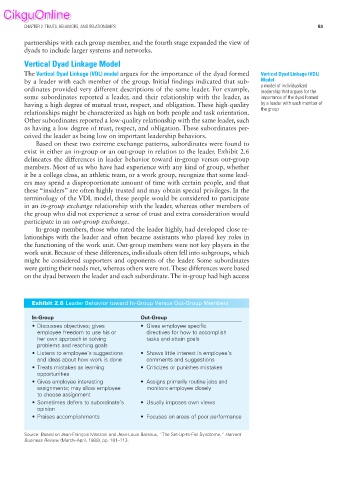
               exist in either an in-group or an out-group in relation to the leader. Exhibit 2.6
               delineates the differences in leader behavior toward in-group versus out-group
               members. Most of us who have had experience with any kind of group, whether
               it be a college class, an athletic team, or a work group, recognize that some lead-
               ers may spend a disproportionate amount of time with certain people, and that
               these “insiders” are often highly trusted and may obtain special privileges. In the
               terminology of the VDL model, these people would be considered to participate
               in an in-group exchange relationship with the leader, whereas other members of
               the group who did not experience a sense of trust and extra consideration would
               participate in an out-group exchange.
                   In-group members, those who rated the leader highly, had developed close re-
               lationships with the leader and often became assistants who played key roles in
               the functioning of the work unit. Out-group members were not key players in the
               work unit. Because of these differences, individuals often fell into subgroups, which
               might be considered supporters and opponents of the leader. Some subordinates
               were  getting their needs met, whereas others were not. These differences were based
               on the dyad between the leader and each subordinate. The in-group had high  access


                  Exhibit 2.6 Leader Behavior toward In-Group Versus Out-Group Members

                  In-Group                         Out-Group
                  •  Discusses objectives; gives    •  Gives employee specific
                   employee freedom to use his or     directives for how to accomplish
                   her own approach in solving       tasks and attain goals
                   problems and reaching goals
                  •  Listens to employee’s suggestions   •  Shows little interest in employee’s
                   and ideas about how work is done     comments and suggestions
                  •  Treats mistakes as learning   •  Criticizes or punishes mistakes
                   opportunities
                  •  Gives employee interesting    •  Assigns primarily routine jobs and
                   assignments; may allow employee      monitors employee closely
                   to choose assignment
                  •  Sometimes defers to subordinate’s    •  Usually imposes own views
                   opinion
                  •  Praises accomplishments       •  Focuses on areas of poor performance

               Source: Based on Jean-François Manzoni and Jean-Louis Barsoux, “The Set-Up-to-Fail Syndrome,” Harvard
               Business Review (March–April, 1988), pp. 101–113.

