


Page 71 - leadership-experience-2008
P. 71
CikguOnline
      CikguOnline
            52                                                                PART 2: RESEARCH PERSPECTIVES ON LEADERSHIP
                                   Individualized Leadership

                                   Traditional trait and behavior theories assume that a leader adopts a general
                                     leadership style that is used with all group members. A more recent approach
                                   to leadership behavior research,  individualized leadership, looks instead at the
                                                                                            40

            Individualized leadership
            Individualized leadership    specific relationship between a leader and each individual member.  Individualized
            a theory based on the notion   leadership is based on the notion that a leader develops a unique relationship with
            a theory based on the notion
            that a leader develops a
            that a leader develops a
            unique relationship with each
            unique relationship with each   each subordinate or group member, which determines how the leader behaves
            subordinate or group member,
            subordinate or group member ,     toward the member and how the member responds to the leader. In this view, lead-
            which determines how the   ership is a series of dyads, or a series of two-person interactions.
            which determines how the
            leader behaves toward the
            leader behaves toward the
            member and how the member
            member and how the member   Sometimes called  dyadic theory, individualized leadership examines why

            responds to the leader  leaders have more influence over and greater impact on some members than on
            responds to the leader

                                   others. To understand leadership, then, a closer look at the specific relationship in
                                   each leader-member dyad is necessary.  The dyadic view focuses on the concept
                                                                    41
                                   of exchange, what each party gives to and receives from the other. Leaders can
                                   meet followers’ emotional needs and offer a sense of support for the follower’s
                                   self-worth, whereas followers provide leaders with commitment and high perfor-
                                   mance. Some dyads might be “rich,” meaning there is a high level of both giving
                                   and receiving by both partners in the exchange, whereas others are “poor,” refl ect-
                                   ing little giving and receiving by dyadic partners. 42

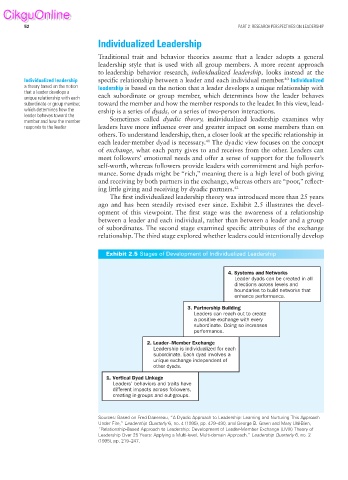
                                       The first individualized leadership theory was introduced more than 25 years
                                   ago and has been steadily revised ever since. Exhibit 2.5 illustrates the devel-
                                   opment of this viewpoint. The first stage was the awareness of a relationship

                                   between a leader and each individual, rather than between a leader and a group

                                   of subordinates. The second stage examined specific attributes of the exchange
                                   relationship. The third stage explored whether leaders could intentionally develop
                                     Exhibit 2.5 Stages of Development of Individualized Leadership
                                                                           4. Systems and Networks
                                                                             Leader dyads can be created in all
                                                                             directions across levels and
                                                                             boundaries to build networks that
                                                                            enhance performance.
                                                              3. Partnership Building
                                                                Leaders can reach out to create
                                                                a positive exchange with every
                                                                subordinate. Doing so increases
                                                               performance.
                                                  2. Leader–Member Exchange
                                                    Leadership is individualized for each
                                                    subordinate. Each dyad involves a
                                                    unique exchange independent of
                                                   other dyads.
                                     1. Vertical Dyad Linkage
                                       Leaders’ behaviors and traits have
                                       different impacts across followers,
                                       creating in-groups and out-groups.


                                   Sources: Based on Fred Danereau, “A Dyadic Approach to Leadership: Learning and Nurturing This Approach
                                   Under Fire,” Leadership Quarterly 6, no. 4 (1995), pp. 479–490, and George B. Graen and Mary Uhl-Bien,
                                   “Relationship-Based Approach to Leadership: Development of Leader-Member Exchange (LMX) Theory of
                                   Leadership Over 25 Years: Applying a Multi-level, Multi-domain Approach,” Leadership Quarterly 6, no. 2
                                   (1995), pp. 219–247.

