


Page 69 - leadership-experience-2008
P. 69
CikguOnline
      CikguOnline
            50                                                                PART 2: RESEARCH PERSPECTIVES ON LEADERSHIP

                                     IN THE LEAD  humor and stories to lighten up intense meetings. At the end of every meeting to
                                       outline new tasks or performance targets, she plays the song, “Nothing’s Gonna
                                       Stop Us Now” to keep people motivated and focused on goals.
                                          Compare Lieberman’s approach as a new CEO at TruServ to  Joyce Pully’s
                                       approach as the new principal of North Jackson Elementary School in Jackson,
                                         Mississippi. Pully had a vision of transforming North Jackson into a model of creative
                                       learning. However, she didn’t make any changes at all during the fi rst year, working
                                       instead to build trust with teachers, staff, and students. She listened carefully to
                                       teachers’ concerns and began involving them closely in decision making. When she
                                       presented ideas for new ways of teaching and learning, Pully assured people she’d
                                       provide them with the training they needed to succeed. When teachers realized
                                       that Pully respected them and truly valued their input, they became more involved
                                       in planning the future of the school. Today, rote teaching and rote learning are gone
                                       at North Jackson, replaced by a vibrant educational process that relies on innova-
                                       tion and discovery. Pully believes the change was possible only because the staff,
                                                                                          35
                                         teachers, and students played an active role in making it happen.
                                       The leadership of Pamela Forbes Lieberman is characterized by high concern
                                   for tasks and production and low-to-moderate concern for people. Joyce Pully, in
                                   contrast, is high on concern for people and moderate on concern for production.
                                   In each case, both concerns shown in the Leadership Grid are present, but they
                                   are integrated at different levels.
                                   Theories of a “High-High” Leader
                                   The leadership styles described by the researchers at Ohio State, University of
                                   Michigan, and University of Texas pertain to variables that roughly correspond
                                   to one another: consideration and initiating structure; employee-centered and job-
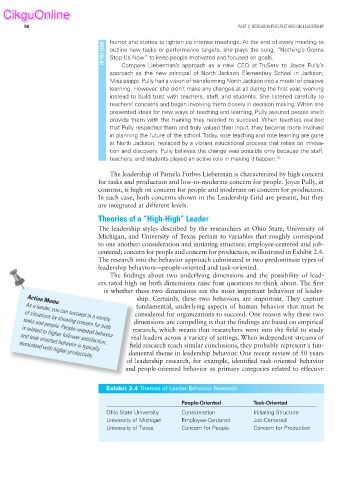
                                   centered; concern for people and concern for production, as illustrated in Exhibit 2.4.
                                   The research into the behavior approach culminated in two predominate types of
                                   leadership  behaviors—people-oriented and task-oriented.
                                       The findings about two underlying dimensions and the possibility of lead-

                                   ers rated high on both dimensions raise four questions to think about. The fi rst
                                     is whether these two dimensions are the most important behaviors of leader-
                                               ship. Certainly, these two behaviors are important. They capture
             Action Memo
                                               fundamental, underlying aspects of human behavior that must be
                                              considered for organizations to succeed. One reason why these two
             As a leader, you can succeed in a variety
                                              dimensions are compelling is that the fi ndings are based on empirical
            of situations by showing concern for both

                                             research, which means that researchers went into the field to study
            tasks and people. People-oriented behavior
                                             real leaders across a variety of settings. When independent streams of
           is related to higher follower satisfaction,

                                             field research reach similar conclusions, they probably represent a fun-
           and task-oriented behavior is typically
                                            damental theme in leadership behavior. One recent review of 50 years
           associated with higher productivity.

                                            of leadership research, for example, identified task-oriented behavior
                                           and people-oriented behavior as primary categories related to effective
                                     Exhibit 2.4 Themes of Leader Behavior Research
                                                             People-Oriented       Task-Oriented
                                     Ohio State University   Consideration         Initiating Structure
                                     University of Michigan   Employee-Centered    Job-Centered
                                     University of Texas     Concern for People    Concern for Production

