


Page 83 - leadership-experience-2008
P. 83
CikguOnline
      CikguOnline
            64                                                                PART 2: RESEARCH PERSPECTIVES ON LEADERSHIP

                                   situations they face. In this chapter, we discuss the elements of leader, follower,
                                   and the situation, and the impact each has upon the others. We examine several
                                   theories that defi ne how leadership styles, follower attributes, and organizational
                                   characteristics fit together to enable successful leadership. The important point

                                   of this chapter is that the most effective leadership approach depends on many
                                   factors. Understanding the contingency approaches can help a leader adapt his or
                                   her approach, although it is important to recognize that leaders also develop their
                                   ability to adapt through experience and practice.


                                   The Contingency Approach
                                   The failure to fi nd universal leader traits or behaviors that would always de-
                                   termine effective leadership led researchers in a new direction. Although leader
                                   behavior was still examined, the central focus of the new research was the
                                   situation in which leadership occurred. The basic tenet of this focus was that
                                   behavior effective in some circumstances might be ineffective under different
                                   conditions. Thus, the effectiveness of leader behavior is contingent upon or-
                                   ganizational situations.  Aptly called  contingency approaches, these theories
                                   explain the relationship between leadership styles and effectiveness in specifi c
                                   situations.
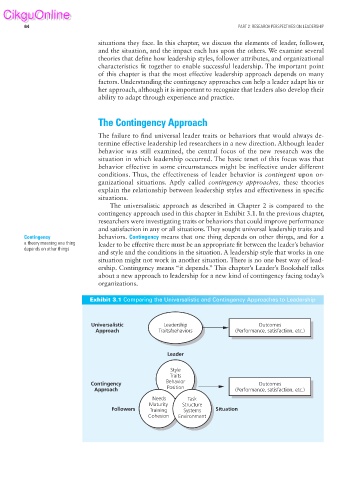
                                       The universalistic approach as described in Chapter 2 is compared to the
                                   contingency approach used in this chapter in Exhibit 3.1. In the previous chapter,
                                   researchers were investigating traits or behaviors that could improve performance
                                   and satisfaction in any or all situations. They sought universal leadership traits and
            Contingency
            Contingency            behaviors. Contingency means that one thing depends on other things, and for a
            a theory meaning one thing   leader to be effective there must be an appropriate fit between the leader’s behavior
            a theory meaning one thing

            depends on other things
            depends on other things
                                   and style and the conditions in the situation. A leadership style that works in one
                                   situation might not work in another situation. There is no one best way of lead-
                                   ership. Contingency means “it depends.” This chapter’s Leader’s Bookshelf talks
                                   about a new approach to leadership for a new kind of contingency facing today’s
                                   organizations.
                                Exhibit 3.1 Comparing the Universalistic and Contingency Approaches to Leadership


                                 Universalistic        Leadership                   Outcomes
                                  Approach            Traits/behaviors       (Performance, satisfaction, etc.)


                                                        Leader

                                                         Style
                                                         Traits
                                 Contingency            Behavior                    Outcomes
                                  Approach              Position             (Performance, satisfaction, etc.)
                                                    Needs      Task
                                                   Maturity  Structure
                                       Followers   Training  Systems   Situation
                                                  Cohesion  Environment

