


Page 85 - leadership-experience-2008
P. 85
CikguOnline
      CikguOnline
            66                                                                PART 2: RESEARCH PERSPECTIVES ON LEADERSHIP

            Contingency approaches  in this chapter. The contingency approaches seek to delineate the characteristics
            approaches that seek to   of situations and followers and examine the leadership styles that can be used
            delineate the characteristics
            of situations and followers and   effectively. Assuming that a leader can properly diagnose a situation and muster
            examine the leadership styles   the fl exibility to behave according to the appropriate style, successful outcomes
            that can be used effectively  are highly likely.
                                       Two basic leadership behaviors that can be adjusted to address various
                                   contingencies are task behavior and relationship behavior, introduced in the previ-
                                   ous chapter. Research has identified these two meta-categories, or broadly defi ned

                                   behavior categories, as applicable to leadership in a variety of situations and time
                                          3
                                   periods.  A leader can adapt his or her style to be high or low on both task and
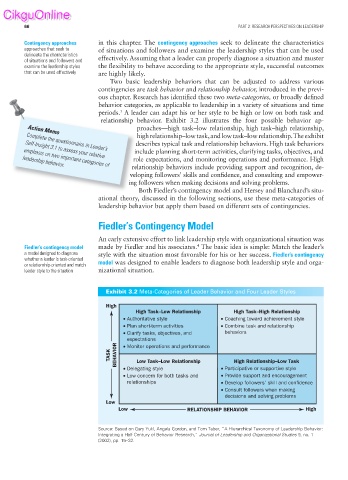
                                    relationship behavior. Exhibit 3.2 illustrates the four possible behavior ap-
                                               proaches—high task–low relationship, high task–high relationship,
             Action Memo
                                               high relationship–low task, and low task–low relationship. The exhibit
                                              describes typical task and relationship behaviors. High task behaviors
             Complete the questionnaire in Leader’s
                                              include planning short-term activities, clarifying tasks,  objectives, and
            Self-Insight 3.1 to assess your relative
                                              role expectations, and monitoring operations and performance. High
            emphasis on two important categories of
            leadership behavior.
                                             relationship behaviors include providing support and recognition, de-
                                             veloping followers’ skills and confidence, and consulting and empower-

                                            ing followers when making decisions and solving problems.
                                               Both Fiedler’s contingency model and Hersey and Blanchard’s situ-
                                   ational theory, discussed in the following sections, use these meta-categories of
                                   leadership behavior but apply them based on different sets of contingencies.

                                   Fiedler’s Contingency Model
                                   An early extensive effort to link leadership style with organizational situation was
                                                                 4
            Fiedler’s contingency model  made by Fiedler and his associates.  The basic idea is simple: Match the leader’s
            a model designed to diagnose   style with the situation most favorable for his or her success. Fiedler’s contingency
            whether a leader is task-oriented
            or relationship-oriented and match   model was designed to enable leaders to diagnose both leadership style and orga-
            leader style to the situation  nizational situation.


                                     Exhibit 3.2 Meta-Categories of Leader Behavior and Four Leader Styles

                                     High
                                               High Task–Low Relationship    High Task–High Relationship
                                           • Authoritative style         • Coaching toward achievement style
                                           • Plan short-term activities  • Combine task and relationship
                                           • Clarify tasks, objectives, and   behaviors
                                            expectations
                                           • Monitor operations and performance
                                       TASK   BEHAVIOR  Low Task–Low Relationship  High Relationship–Low Task


                                           • Delegating style            • Participative or supportive style
                                           • Low concern for both tasks and  • Provide support and encouragement
                                            relationships                • Develop followers’ skill and confidence
                                                                         • Consult followers when making
                                                                           decisions and solving problems
                                     Low
                                         Low                  RELATIONSHIP BEHAVIOR                High


                                   Source: Based on Gary Yukl, Angela Gordon, and Tom Taber, “A Hierarchical Taxonomy of Leadership Behavior:
                                   Integrating a Half Century of Behavior Research,” Journal of Leadership and Organizational Studies 9, no. 1
                                   (2002), pp. 15–32.

