


Page 97 - leadership-experience-2008
P. 97
CikguOnline
      CikguOnline
            78                                                                PART 2: RESEARCH PERSPECTIVES ON LEADERSHIP

                                     Exhibit 3.6 Path–Goal Situations and Preferred Leader Behaviors

                                    Situation        Leader Behavior      Impact on Follower  Outcome


                                                                       Increases confidence
                                    Follower lacks     Supportive
                                    self-confidence    Leadership      to achieve work
                                                                       outcome


                                                       Directive       Clarifies path
                                    Ambiguous job
                                                       Leadership      to reward              Increased
                                                                                              effort;
                                                                                              improved
                                                                                              satisfaction
                                                                                              and
                                                       Achievement-
                                    Lack of job                        Sets and strives       performance
                                    challenge          Oriented        for parallel structure
                                                       Leadership


                                    Incorrect          Participative   Clarifies followers’
                                    reward             Leadership      needs to change
                                                                       rewards


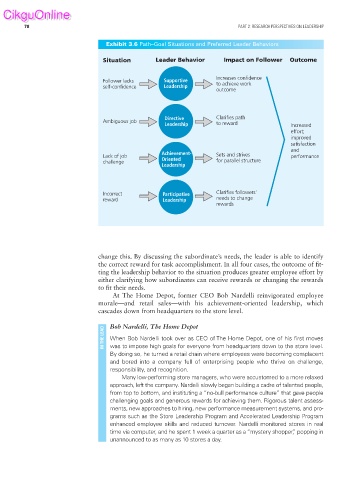
                                   change this. By discussing the subordinate’s needs, the leader is able to identify
                                   the correct reward for task accomplishment. In all four cases, the outcome of fi t-
                                   ting the leadership behavior to the situation produces greater employee effort by
                                   either clarifying how subordinates can receive rewards or changing the rewards
                                   to fi t their needs.
                                        At The Home Depot, former CEO Bob Nardelli reinvigorated employee
                                     morale—and retail sales—with his achievement-oriented leadership, which
                                     cascades down from headquarters to the store level.


                                     IN THE LEAD  Bob Nardelli, The Home Depot
                                       When Bob Nardelli took over as CEO of The Home Depot, one of his fi rst moves
                                       was to impose high goals for everyone from headquarters down to the store level.
                                       By doing so, he turned a retail chain where employees were becoming complacent
                                       and bored into a company full of enterprising people who thrive on challenge,
                                       responsibility, and recognition.
                                          Many low-performing store managers, who were accustomed to a more relaxed
                                       approach, left the company. Nardelli slowly began building a cadre of talented people,
                                       from top to bottom, and instituting a “no-bull performance culture” that gave people
                                       challenging goals and generous rewards for achieving them. Rigorous talent assess-
                                       ments, new approaches to hiring, new performance measurement systems, and pro-
                                       grams such as the Store Leadership Program and Accelerated Leadership Program
                                       enhanced employee skills and reduced turnover. Nardelli monitored stores in real
                                       time via computer, and he spent 1 week a quarter as a “mystery shopper,” popping in
                                       unannounced to as many as 10 stores a day.

