


Page 57 - Nursing: The Philosophy and Science of Caring
P. 57
c a ra tiv e  F act or s/ C ar it as ProC e s se s
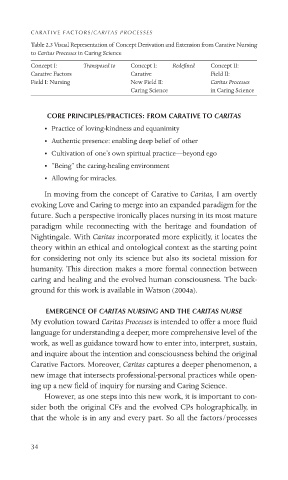
           Table 2.3 Visual Representation of Concept Derivation and Extension from Carative Nursing
           to Caritas Processes in Caring Science
           Concept I:    Transposed to   Concept I:    Redefined   Concept II:
           Carative Factors          Carative             Field II:
           Field I: Nursing          New Field II:        Caritas Processes
                                     Caring Science       in Caring Science


               Core prinCiples/prACtiCes: from CArAtive to Caritas
               •  Practice of loving-kindness and equanimity
               •  Authentic presence: enabling deep belief of other
               •  Cultivation of one’s own spiritual practice—beyond ego
               •  “Being” the caring-healing environment
               •  Allowing for miracles.

               In moving from the concept of Carative to Caritas, I am overtly
           evoking Love and Caring to merge into an expanded paradigm for the
           future. Such a perspective ironically places nursing in its most mature
           paradigm  while  reconnecting  with  the  heritage  and  foundation  of
           Nightingale. With Caritas incorporated more explicitly, it locates the
           theory within an ethical and ontological context as the starting point
           for considering not only its science but also its societal mission for
           humanity. This direction makes a more formal connection between
           caring and healing and the evolved human consciousness. The back-
           ground for this work is available in Watson (2004a).


               emergenCe of Caritas NursiNg And the Caritas Nurse
           My evolution toward Caritas Processes is intended to offer a more fluid
           language for understanding a deeper, more comprehensive level of the
           work, as well as guidance toward how to enter into, interpret, sustain,
           and inquire about the intention and consciousness behind the original
           Carative Factors. Moreover, Caritas captures a deeper phenomenon, a
           new image that intersects professional-personal practices while open-
           ing up a new field of inquiry for nursing and Caring Science.
              However, as one steps into this new work, it is important to con-
           sider both the original CFs and the evolved CPs holographically, in
           that the whole is in any and every part. So all the factors/processes


           34

