


Page 53 - Nursing: The Philosophy and Science of Caring
P. 53
c a ra tiv e  F act or s/ C ar it as ProC e s se s
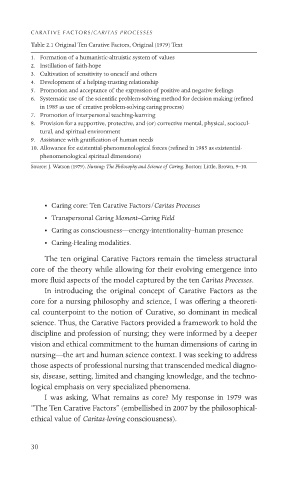
           Table 2.1 Original Ten Carative Factors, Original (1979) Text
           1.  Formation of a humanistic-altruistic system of values
           2.  Instillation of faith-hope
           3.  Cultivation of sensitivity to oneself and others
           4.  Development of a helping-trusting relationship
           5.  Promotion and acceptance of the expression of positive and negative feelings
           6.  Systematic use of the scientific problem-solving method for decision making (refined
             in 1985 as use of creative problem-solving caring process)
           7.  Promotion of interpersonal teaching-learning
           8.  Provision for a supportive, protective, and (or) corrective mental, physical, sociocul-
             tural, and spiritual environment
           9.  Assistance with gratification of human needs
           10. Allowance for existential-phenomenological forces (refined in 1985 as existential-
               phenomenological spiritual dimensions)
           Source: J. Watson (1979). Nursing: The Philosophy and Science of  Caring. Boston: Little, Brown, 9–10.


               •  Caring core: Ten Carative Factors/Caritas Processes

               •  Transpersonal Caring Moment–Caring Field
              •  Caring as consciousness—energy-intentionality–human presence
              •  Caring-Healing modalities.
               The ten original Carative Factors remain the timeless structural
           core of the theory while allowing for their evolving emergence into
           more fluid aspects of the model captured by the ten Caritas Processes.
               In  introducing  the  original  concept  of  Carative  Factors  as  the
           core for a nursing philosophy and science, I was offering a theoreti-
           cal counterpoint to the notion of Curative, so dominant in medical
           science. Thus, the Carative Factors provided a framework to hold the
           discipline and profession of nursing; they were informed by a deeper
           vision and ethical commitment to the human dimensions of caring in
           nursing—the art and human science context. I was seeking to address
           those aspects of professional nursing that transcended medical diagno-
           sis, disease, setting, limited and changing knowledge, and the techno-
           logical emphasis on very specialized phenomena.
               I was asking, What remains as core? My response in 1979 was
           “The Ten Carative Factors” (embellished in 2007 by the philosophical-
           ethical value of Caritas-loving consciousness).


           30

