


Page 11 - PPE GUIDELINE
P. 11
Guidelines on the Use of PPE Against Chemical Hazards
Personal protective equipment should not be used if the risk caused by wearing it is
greater than the protection it is supposed to provide. A good example is the use
respirator that is supposed to protect the wearer against airborne contaminant but if
the wearer is asthmatic or has heart problem, the respirator could cause breathing
difficulty for him.
3.1. Risk Associated With Hazardous Chemicals
Basically the risks associated with hazardous chemicals are either by inhalation of the
particulates or gases and vapours or the direct contact of the chemicals with the skin,
or eyes. The protection required against these risks can be addressed based on the part
of the body where contact takes place, viz. the head, face/eyes, respiratory system
(nose/mouth), body, hand and leg/feet.
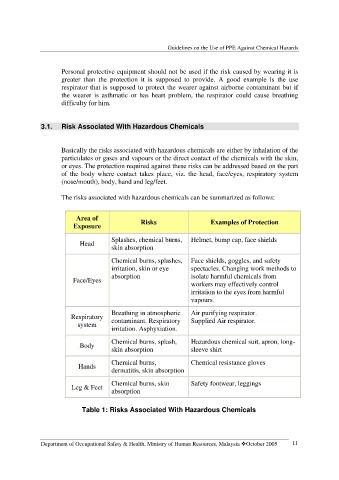
The risks associated with hazardous chemicals can be summarized as follows:
Area of Risks Examples of Protection
Exposure
Splashes, chemical burns, Helmet, bump cap, face shields
Head skin absorption
Chemical burns, splashes, Face shields, goggles, and safety
irritation, skin or eye spectacles. Changing work methods to
Face/Eyes absorption isolate harmful chemicals from
workers may effectively control
irritation to the eyes from harmful
vapours.
Respiratory Breathing in atmospheric Air purifying respirator.
system contaminant. Respiratory Supplied Air respirator.
irritation. Asphyxiation.
Chemical burns, splash, Hazardous chemical suit, apron, long-
Body skin absorption sleeve shirt
Hands Chemical burns, Chemical resistance gloves
dermatitis, skin absorption
Leg & Feet Chemical burns, skin Safety footwear, leggings
absorption
Table 1: Risks Associated With Hazardous Chemicals
Department of Occupational Safety & Health, Ministry of Human Resources, Malaysia October 2005 11

