


Page 14 - PPE GUIDELINE
P. 14
Guidelines on the Use of PPE Against Chemical Hazards
Hazards posed by Helmets
Persons working overhead should wear helmets with chinstrap to secure the hat from
becoming a falling object itself.
3.2.2. Eyes and Face Protection
The eyes and face have to be protected against the hazard of impact, splashes from
chemicals or molten metal, liquid droplets (chemical mist and sprays), gases, dust,
welding arcs (sparks, fumes and ultraviolet radiation), non-ionising radiation and the
light from lasers.
Types
Eye and face protectors include:
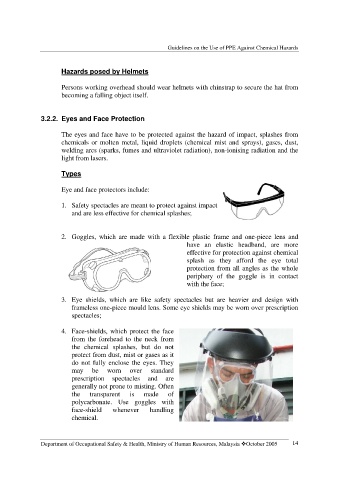
1. Safety spectacles are meant to protect against impact
and are less effective for chemical splashes;
2. Goggles, which are made with a flexible plastic frame and one-piece lens and
have an elastic headband, are more
effective for protection against chemical
splash as they afford the eye total
protection from all angles as the whole
periphery of the goggle is in contact
with the face;
3. Eye shields, which are like safety spectacles but are heavier and design with
frameless one-piece mould lens. Some eye shields may be worn over prescription
spectacles;
4. Face-shields, which protect the face
from the forehead to the neck from
the chemical splashes, but do not
protect from dust, mist or gases as it
do not fully enclose the eyes. They
may be worn over standard
prescription spectacles and are
generally not prone to misting. Often
the transparent is made of
polycarbonate. Use goggles with
face-shield whenever handling
chemical.
Department of Occupational Safety & Health, Ministry of Human Resources, Malaysia October 2005 14

