


Page 148 - Essentials of Nursing Leadership and Management, 5th Edition
P. 148
CikguOnline
         2208_Ch10_131-156.qxd  11/6/09  5:59 PM  Page 135
                                                                             chapter 10 | Quality and Safety 135           CikguOnline
                 strategy and action plans to redesign the health-care  box 10-5
                 system.The report stated that the gaps between actu-
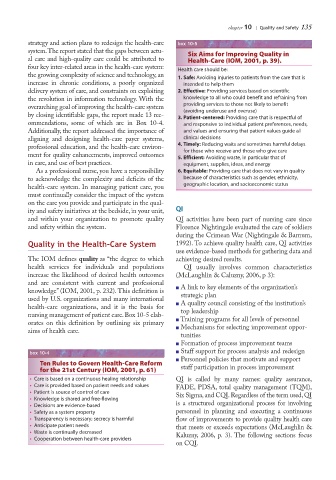
                                                                 Six Aims for Improving Quality in
                 al care and high-quality care could be attributed to  Health-Care (IOM, 2001, p. 39).
                 four key inter-related areas in the health-care system:
                                                              Health care should be:
                 the growing complexity of science and technology,an
                                                              1. Safe: Avoiding injuries to patients from the care that is
                 increase in chronic conditions, a poorly organized  intended to help them
                 delivery system of care, and constraints on exploiting  2. Effective: Providing services based on scientific
                 the revolution in information technology. With the  knowledge to all who could benefit and refraining from
                 overarching goal of improving the health-care system  providing services to those not likely to benefit
                                                               (avoiding underuse and overuse)
                 by closing identifiable gaps, the report made 13 rec-
                                                              3. Patient-centered: Providing care that is respectful of
                 ommendations, some of which are in Box 10-4.  and responsive to individual patient preferences, needs,
                 Additionally, the report addressed the importance of  and values and ensuring that patient values guide all
                 aligning and designing health-care payer systems,  clinical decisions
                 professional education, and the health-care environ-  4. Timely: Reducing waits and sometimes harmful delays
                                                               for those who receive and those who give care
                 ment for quality enhancements, improved outcomes
                                                              5. Efficient: Avoiding waste, in particular that of
                 in care, and use of best practices.           equipment, supplies, ideas, and energy
                   As a professional nurse, you have a responsibility  6. Equitable: Providing care that does not vary in quality
                 to acknowledge the complexity and deficits of the  because of characteristics such as gender, ethnicity,
                 health-care system. In managing patient care, you  geographic location, and socioeconomic status
                 must continually consider the impact of the system
                 on the care you provide and participate in the qual-
                 ity and safety initiatives at the bedside, in your unit,  QI
                 and within your organization to promote quality  QI activities have been part of nursing care since
                 and safety within the system.               Florence Nightingale evaluated the care of soldiers
                                                             during the Crimean War (Nightingale & Barnum,
                 Quality in the Health-Care System           1992). To achieve quality health care, QI activities
                                                             use evidence-based methods for gathering data and
                 The IOM defines quality as “the degree to which  achieving desired results.
                 health services for individuals and populations  QI usually involves common characteristics
                 increase the likelihood of desired health outcomes  (McLaughlin & Caluzny, 2006, p 3):
                 and are consistent with current and professional
                                                             ■ A link to key elements of the organization’s
                 knowledge” (IOM, 2001, p. 232). This definition is
                                                              strategic plan
                 used by U.S. organizations and many international
                                                             ■ A quality council consisting of the institution’s
                 health-care organizations, and it is the basis for
                                                              top leadership
                 nursing management of patient care.Box 10-5 elab-
                                                             ■ Training programs for all levels of personnel
                 orates on this definition by outlining six primary
                                                             ■ Mechanisms for selecting improvement oppor-
                 aims of health care.
                                                              tunities
                                                             ■ Formation of process improvement teams
                                                             ■ Staff support for process analysis and redesign
                 box 10-4
                                                             ■ Personnel policies that motivate and support
                    Ten Rules to Govern Health-Care Reform
                    for the 21st Century (IOM, 2001, p. 61)   staff participation in process improvement
                 • Care is based on a continuous healing relationship  QI is called by many names: quality assurance,
                 • Care is provided based on patient needs and values  FADE, PDSA, total quality management (TQM),
                 • Patient is source of control of care      Six Sigma,and CQI.Regardless of the term used,QI
                 • Knowledge is shared and free-flowing
                 • Decisions are evidence-based              is a structured organizational process for involving
                 • Safety as a system property               personnel in planning and executing a continuous
                 • Transparency is necessary; secrecy is harmful  flow of improvements to provide quality health care
                 • Anticipate patient needs                  that meets or exceeds expectations (McLaughlin &
                 • Waste is continually decreased            Kaluzny, 2006, p. 3). The following sections focus
                 • Cooperation between health-care providers
                                                             on CQI.

