


Page 150 - Essentials of Nursing Leadership and Management, 5th Edition
P. 150
CikguOnline
         2208_Ch10_131-156.qxd  11/6/09  5:59 PM  Page 137
                                                                             chapter 10 | Quality and Safety 137           CikguOnline
                 ■ Assists benchmarking and performance      Structured Care Methodologies
                  monitoring
                                                             Most agencies have tools for tracking outcomes.
                 ■ Stimulates change and becomes the building block
                                                             These tools are called structured care methodologies
                  for the next plan (planware.org/strategy.htm)
                                                             (SCMs). SCMs are interdisciplinary tools to “iden-
                 During the strategic planning process, the organi-  tify best practices, facilitate standardization of care,
                 zation develops or reviews its vision, mission state-  and provide a mechanism for variance tracking,
                 ment, and corporate values. A group develops   quality enhancement, outcomes measurement, and
                 business objectives and key strategies to meet these  outcomes research” (Cole & Houston, 1999, p. 53).
                 objectives. In order to do this, a SWOT analysis is  SCMs include guidelines, protocols, algorithms,
                 done—a review of the organization’s Strengths,  standards of care, critical pathways, and order sets.
                 Weaknesses, Opportunities, and Threats. Key
                                                             ■ Guidelines. Guidelines first appeared in the
                 strategies are identified, and action plans are devel-
                                                              1980s as statements to assist health-care
                 oped. The organization’s mission, goals, and strate-
                                                              providers and patients in making appropriate
                 gic plan ultimately drive the outcomes and QI plan
                                                              health-care decisions. Guidelines are based on
                 for that organization. Be proactive, and participate
                                                              current research strategies and are often devel-
                 in the process. Ask your nurse manager if there are
                                                              oped by experts in the field.The use of guidelines
                 opportunities for the staff to participate in the
                                                              is seen as a way to decrease variations in practice.
                 planning process.
                                                             ■ Protocols. Protocols are specific, formal docu-
                   Issues related to QI may also come out of the
                                                              ments that outline how a procedure or interven-
                 strategic planning process. Quality issues are not
                                                              tion should be conducted. Protocols have been
                 often apparent to senior managers. Staff members
                                                              used for many years in research and specialty
                 at the unit level can often identify quality issues
                                                              areas but have been introduced into general
                 because they are the ones who can feel the impact
                                                              health care as a way to standardize approaches
                 when quality is lacking. Once a process that needs
                                                              to achieve desired outcomes. An example in
                 improvement is identified, an interdisciplinary
                                                              many facilities is a chest pain protocol.
                 team is organized whose members have knowledge
                                                             ■ Algorithms. Algorithms are systematic proce-
                 of the identified process. The team members meet
                                                              dures that follow a logical progression based on
                 to identify and analyze problems, discuss solutions,
                                                              additional information or patient responses to
                 and evaluate changes. The team clarifies the cur-
                                                              treatment. They were originally developed in
                 rent knowledge of the process; it identifies causes
                                                              mathematics and are frequently seen in
                 for variations in the process and works to unify the
                                                              emergency medical services. Advanced cardiac
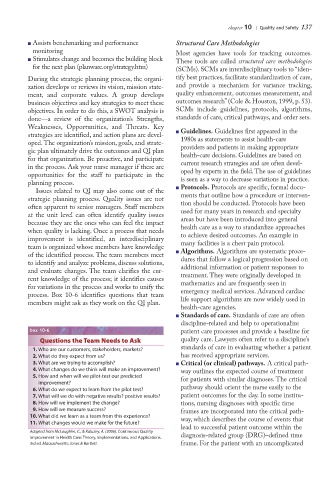
                 process. Box 10-6 identifies questions that team
                                                              life support algorithms are now widely used in
                 members might ask as they work on the QI plan.
                                                              health-care agencies.
                                                             ■ Standards of care. Standards of care are often
                                                              discipline-related and help to operationalize
                 box 10-6                                     patient care processes and provide a baseline for
                    Questions the Team Needs to Ask           quality care. Lawyers often refer to a discipline’s
                                                              standards of care in evaluating whether a patient
                  1. Who are our customers, stakeholders, markets?
                  2. What do they expect from us?             has received appropriate services.
                  3. What are we trying to accomplish?       ■ Critical (or clinical) pathways. A critical path-
                  4. What changes do we think will make an improvement?  way outlines the expected course of treatment
                  5. How and when will we pilot-test our predicted  for patients with similar diagnoses. The critical
                    improvement?
                  6. What do we expect to learn from the pilot test?  pathway should orient the nurse easily to the
                  7. What will we do with negative results? positive results?  patient outcomes for the day. In some institu-
                  8. How will we implement the change?        tions, nursing diagnoses with specific time
                  9. How will we measure success?             frames are incorporated into the critical path-
                 10. What did we learn as a team from this experience?  way, which describes the course of events that
                 11. What changes would we make for the future?
                                                              lead to successful patient outcome within the
                 Adapted from McLaughlin, C., & Kaluzny, A. (2006). Continuous Quality
                                                              diagnosis-related group (DRG)–defined time
                 Improvement in Health Care: Theory, Implementations, and Applications.
                 3rd ed. Massachusetts: Jones & Bartlett.     frame. For the patient with an uncomplicated

