


Page 149 - Essentials of Nursing Leadership and Management, 5th Edition
P. 149
CikguOnline
         2208_Ch10_131-156.qxd  11/6/09  5:59 PM  Page 136
               136   unit 2 | Working Within the Organization                                                              CikguOnline
               Using CQI to Monitor and Evaluate Quality                Assign Responsibilities
               of Care
               Continuous quality improvement (CQI) is a
               process of identifying areas of concern (indicators),
               continuously collecting data on these indicators,          Identify Vital Areas
               analyzing and evaluating the data, and implement-
               ing needed changes. When one indicator is no
               longer a concern, another indicator is selected.
                                                                         Define Scope of Care
               Common indicators include, for example, number
               of falls, medication errors, and infection rates.
               Indicators can be identified by the accrediting
               agency or by the facility itself.The purpose of CQI     Analyze Area in Terms of:
               is to improve the capability continuously of every-
                                                                              Aspects
               one involved in providing care, including the                 Standards
               organization itself. CQI aims to avoid a blaming              Indicators
               environment and attempts to provide a means to                 Criteria
               improve the entire system.
                  CQI relies on collecting information and analyz-
               ing it. The time frame used in a CQI program can
               be retrospective (evaluating past performance, often   Measure Actual Performance
                                                                               and
               called quality assurance), concurrent (evaluating cur-  Measure Patient Outcomes
               rent performance), or prospective (future-oriented,
               collecting data as they come in). The procedures
               used to collect data depend on the purpose of the
               program. Data may be obtained by observation, per-  Evaluate Performance and Outcomes
               formance appraisals, patient satisfaction surveys,
               statistical analyses of length-of-stay and costs, sur-
               veys, peer reviews, and chart audits (Huber, 2000).
                                                                   Recommend and Implement Actions
                  In the CQI framework, data collection is every-
               one’s responsibility. Collecting comprehensive, accu-
               rate, and representative data is the first step in the
               CQI process. You may be asked to brainstorm your     Evaluate Degree of Improvement
               ideas with other nurses or members of the interdis-
               ciplinary team, complete surveys or checklists, or  Figure 10.1 Unit level QI process. (Adapted from Hunt,
               keep a log of your daily activities. How do you  D.V. [1992]. Quality in America: How to Implement a
                                                            Competitive Quality Program. Homewood, IL: Business
               administer medications to groups of patients? What
                                                            One Irwin; and Duquette, A.M. [1991]. Approaches to
               steps are involved? Are the medications always avail-  monitoring practice: Getting started. In Schroeder,
               able at the right time and in the right dose,or do you  P. [ed.]. Monitoring and Evaluation in Nursing.
               have to wait for the pharmacy to bring them to the  Gaithersburg, MD: Aspen.)
               floor? Is the pharmacy technician delayed by emer-
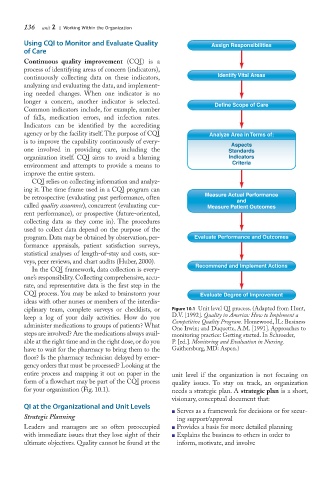
               gency orders that must be processed? Looking at the
               entire process and mapping it out on paper in the  unit level if the organization is not focusing on
               form of a flowchart may be part of the CQI process  quality issues. To stay on track, an organization
               for your organization (Fig. 10.1).           needs a strategic plan. A strategic plan is a short,
                                                            visionary, conceptual document that:
               QI at the Organizational and Unit Levels
                                                            ■ Serves as a framework for decisions or for secur-
               Strategic Planning                            ing support/approval
               Leaders and managers are so often preoccupied  ■ Provides a basis for more detailed planning
               with immediate issues that they lose sight of their  ■ Explains the business to others in order to
               ultimate objectives. Quality cannot be found at the  inform, motivate, and involve

