


Page 191 - Essentials of Nursing Leadership and Management, 5th Edition
P. 191
CikguOnline
         2208_Ch12_169-196.qxd  11/6/09  6:01 PM  Page 178
               178   unit 3 | Professional Issues                                                                          CikguOnline
                 a physician. “I’m tired of waiting. Let’s get this show  box 12-4
                 on the road,” he screamed loudly as Ms. Jones walked
                                                               When an Assault Occurs:
                 by. “I’m sorry you have to wait, Mr. P., but the doctor  Placing Blame on Victims
                 is busy with another patient and will get to you as
                                                            • Victim gender: Women receive more blame than men.
                 soon as possible.”She handed him a cup of juice she had  • Subject gender: Female victims receive more blame
                 been bringing to another patient. He grabbed the cup,  from women than men.
                 threw it in her face, and then grabbed her arm.  • Severity: The more severe the assault, the more often
                 Slamming her against the wall, he jumped off the  the victim is blamed.
                                                            • Beliefs: The world is a just place, and therefore the
                 stretcher and yelled obscenities at her. He continued to
                                                              person deserves the misfortune.
                 scream in her face until a security guard intervened.  • Age of victim: The older the victim, the more he or she is
                                                              held to blame.
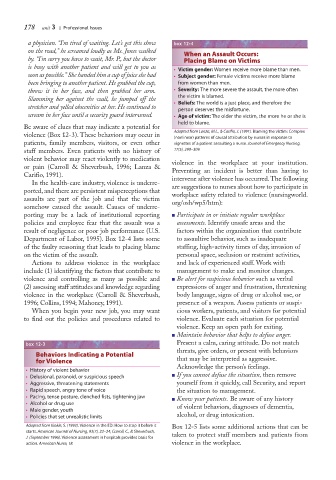
               Be aware of clues that may indicate a potential for
                                                            Adapted from Lanza, M.L., & Carifio, J. (1991). Blaming the victim: Complex
               violence (Box 12-3). These behaviors may occur in
                                                            (nonlinear) patterns of causal attribution by nurses in response to
               patients, family members, visitors, or even other  vignettes of a patient assaulting a nurse. Journal of Emergency Nursing,
               staff members. Even patients with no history of  17(5), 299–309.
               violent behavior may react violently to medication
                                                            violence in the workplace at your institution.
               or pain (Carroll & Sheverbush, 1996; Lanza &
                                                            Preventing an incident is better than having to
               Carifio, 1991).
                                                            intervene after violence has occurred.The following
                  In the health-care industry, violence is underre-
                                                            are suggestions to nurses about how to participate in
               ported, and there are persistent misperceptions that
                                                            workplace safety related to violence (nursingworld.
               assaults are part of the job and that the victim
                                                            org/osh/wp5/htm):
               somehow caused the assault. Causes of underre-
               porting may be a lack of institutional reporting  ■ Participate in or initiate regular workplace
               policies and employee fear that the assault was a  assessments. Identify unsafe areas and the
               result of negligence or poor job performance (U.S.  factors within the organization that contribute
               Department of Labor, 1995). Box 12-4 lists some  to assaultive behavior, such as inadequate
               of the faulty reasoning that leads to placing blame  staffing, high-activity times of day, invasion of
               on the victim of the assault.                 personal space, seclusion or restraint activities,
                  Actions to address violence in the workplace  and lack of experienced staff. Work with
               include (1) identifying the factors that contribute to  management to make and monitor changes.
               violence and controlling as many as possible and   ■ Be alert for suspicious behavior such as verbal
               (2) assessing staff attitudes and knowledge regarding  expressions of anger and frustration, threatening
               violence in the workplace (Carroll & Sheverbush,  body language, signs of drug or alcohol use, or
               1996; Collins, 1994; Mahoney, 1991).          presence of a weapon. Assess patients or suspi-
                  When you begin your new job, you may want   cious workers, patients, and visitors for potential
               to find out the policies and procedures related to  violence. Evaluate each situation for potential
                                                             violence. Keep an open path for exiting.
                                                            ■ Maintain behavior that helps to defuse anger.
                box 12-3                                     Present a calm, caring attitude. Do not match
                                                             threats, give orders, or present with behaviors
                   Behaviors Indicating a Potential
                   for Violence                              that may be interpreted as aggressive.
                                                             Acknowledge the person’s feelings.
                • History of violent behavior
                • Delusional, paranoid, or suspicious speech  ■ If you cannot defuse the situation, then remove
                • Aggressive, threatening statements         yourself from it quickly, call Security, and report
                • Rapid speech, angry tone of voice          the situation to management.
                • Pacing, tense posture, clenched fists, tightening jaw  ■ Know your patients. Be aware of any history
                • Alcohol or drug use                        of violent behaviors, diagnoses of dementia,
                • Male gender, youth
                • Policies that set unrealistic limits       alcohol, or drug intoxication.
                Adapted from Kinkle, S. (1993). Violence in the ED: How to stop it before it  Box 12-5 lists some additional actions that can be
                starts. American Journal of Nursing, 93(7), 22–24; Carroll, C., & Sheverbush,
                J. (September 1996). Violence assessment in hospitals provides basis for  taken to protect staff members and patients from
                action. American Nurse, 18.                 violence in the workplace.

