


Page 96 - Essentials of Nursing Leadership and Management, 5th Edition
P. 96
CikguOnline
         2208_Ch06_071-090.qxd  11/6/09  5:57 PM  Page 83
                                                                     chapter 6 | Getting People to Work Together 83        CikguOnline
                 that a behavior has been judged satisfactory or  too much of your time.”) and to add a suggestion
                 unsatisfactory. If the message is negative, it should  for change (e.g., “You could get your bath supplies
                 include both suggestions and support for change  together while he finishes.”).
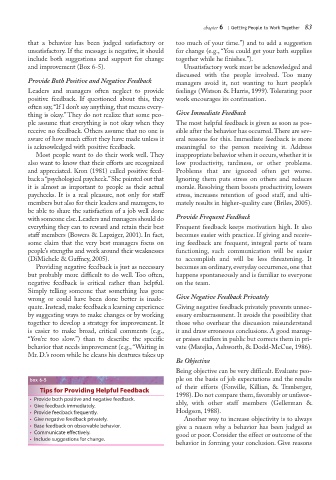
                 and improvement (Box 6-5).                    Unsatisfactory work must be acknowledged and
                                                             discussed with the people involved. Too many
                 Provide Both Positive and Negative Feedback  managers avoid it, not wanting to hurt people’s
                 Leaders and managers often neglect to provide  feelings (Watson & Harris, 1999). Tolerating poor
                 positive feedback. If questioned about this, they  work encourages its continuation.
                 often say,“If I don’t say anything, that means every-
                 thing is okay.” They do not realize that some peo-  Give Immediate Feedback
                 ple assume that everything is not okay when they  The most helpful feedback is given as soon as pos-
                 receive no feedback. Others assume that no one is  sible after the behavior has occurred.There are sev-
                 aware of how much effort they have made unless it  eral reasons for this. Immediate feedback is more
                 is acknowledged with positive feedback.     meaningful to the person receiving it. Address
                   Most people want to do their work well. They  inappropriate behavior when it occurs, whether it is
                 also want to know that their efforts are recognized  low productivity, tardiness, or other problems.
                 and appreciated. Kron (1981) called positive feed-  Problems that are ignored often get worse.
                 back a “psychological paycheck.”She pointed out that  Ignoring them puts stress on others and reduces
                 it is almost as important to people as their actual  morale. Resolving them boosts productivity, lowers
                 paychecks. It is a real pleasure, not only for staff  stress, increases retention of good staff, and ulti-
                 members but also for their leaders and managers, to  mately results in higher-quality care (Briles, 2005).
                 be able to share the satisfaction of a job well done
                 with someone else.Leaders and managers should do  Provide Frequent Feedback
                 everything they can to reward and retain their best  Frequent feedback keeps motivation high. It also
                 staff members (Bowers & Lapziger, 2001). In fact,  becomes easier with practice. If giving and receiv-
                 some claim that the very best managers focus on  ing feedback are frequent, integral parts of team
                 people’s strengths and work around their weaknesses  functioning, such communication will be easier
                 (DiMichele & Gaffney, 2005).                to accomplish and will be less threatening. It
                   Providing negative feedback is just as necessary  becomes an ordinary, everyday occurrence, one that
                 but probably more difficult to do well. Too often,  happens spontaneously and is familiar to everyone
                 negative feedback is critical rather than helpful.  on the team.
                 Simply telling someone that something has gone
                 wrong or could have been done better is inade-  Give Negative Feedback Privately
                 quate.Instead,make feedback a learning experience  Giving negative feedback privately prevents unnec-
                 by suggesting ways to make changes or by working  essary embarrassment. It avoids the possibility that
                 together to develop a strategy for improvement. It  those who overhear the discussion misunderstand
                 is easier to make broad, critical comments (e.g.,  it and draw erroneous conclusions. A good manag-
                 “You’re too slow.”) than to describe the specific  er praises staffers in public but corrects them in pri-
                 behavior that needs improvement (e.g.,“Waiting in  vate (Matejka, Ashworth, & Dodd-McCue, 1986).
                 Mr. D.’s room while he cleans his dentures takes up
                                                             Be Objective
                                                             Being objective can be very difficult. Evaluate peo-
                 box 6-5                                     ple on the basis of job expectations and the results
                                                             of their efforts (Fonville, Killian, &  Tranberger,
                    Tips for Providing Helpful Feedback
                                                             1998). Do not compare them, favorably or unfavor-
                 • Provide both positive and negative feedback.
                                                             ably, with other staff members (Gellerman &
                 • Give feedback immediately.
                                                             Hodgson, 1988).
                 • Provide feedback frequently.
                 • Give negative feedback privately.           Another way to increase objectivity is to always
                 • Base feedback on observable behavior.     give a reason why a behavior has been judged as
                 • Communicate effectively.
                                                             good or poor. Consider the effect or outcome of the
                 • Include suggestions for change.
                                                             behavior in forming your conclusion. Give reasons

