


Page 95 - Essentials of Nursing Leadership and Management, 5th Edition
P. 95
CikguOnline
         2208_Ch06_071-090.qxd  11/6/09  5:57 PM  Page 82
               82   unit 2 | Working Within the Organization                                                               CikguOnline
               For many patients, a written preoperative and/or  the most productive and encourages continua-
               postoperative teaching guide helps to clarify the  tion of those behaviors.
               instructions.                                ■ Discourages unproductive behavior.
                                                             Correction of inappropriate behavior begins
               Feedback                                      with provision of negative feedback.
                                                            ■ Provides recognition. The power of praise
               Why Do People Need Feedback?                  (positive feedback) to motivate people is under-
                 In good weather, Herbert usually played basketball  estimated.
                 with his kids after dinner. Yesterday, however, he  ■ Develops employee skills. Feedback helps peo-
                 told them he was too tired. This evening, he said the  ple identify their strengths and weaknesses and
                 same thing.When they urged him to play anyway, he  guides them in seeking opportunities to further
                 snapped at them and told them to leave him alone.  develop their strengths and manage their weak-
                   “Herbert!” his wife exclaimed, “Why did you do  nesses (Rosen, 1996).
                 that?”
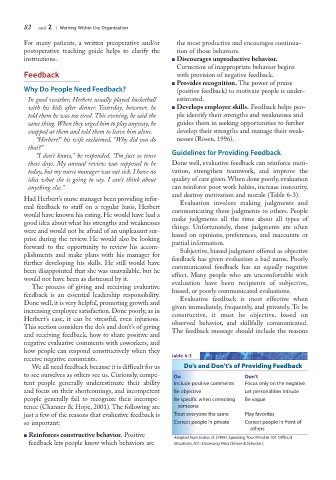
                                                            Guidelines for Providing Feedback
                   “I don’t know,” he responded. “I’m just so tense
                 these days. My annual review was supposed to be  Done well, evaluative feedback can reinforce moti-
                 today, but my nurse manager was out sick. I have no  vation, strengthen teamwork, and improve the
                 idea what she is going to say. I can’t think about  quality of care given.When done poorly, evaluation
                 anything else.”                            can reinforce poor work habits, increase insecurity,
                                                            and destroy motivation and morale (Table 6-3).
               Had Herbert’s nurse manager been providing infor-
                                                              Evaluation involves making judgments and
               mal feedback to staff on a regular basis, Herbert
                                                            communicating these judgments to others. People
               would have known his rating. He would have had a
                                                            make judgments all the time about all types of
               good idea about what his strengths and weaknesses
                                                            things. Unfortunately, these judgments are often
               were and would not be afraid of an unpleasant sur-
                                                            based on opinions, preferences, and inaccurate or
               prise during the review. He would also be looking
                                                            partial information.
               forward to the opportunity to review his accom-
                                                              Subjective, biased judgment offered as objective
               plishments and make plans with his manager for
                                                            feedback has given evaluation a bad name. Poorly
               further developing his skills. He still would have
                                                            communicated feedback has an equally negative
               been disappointed that she was unavailable, but he
                                                            effect. Many people who are uncomfortable with
               would not have been as distressed by it.
                                                            evaluation have been recipients of subjective,
                  The process of giving and receiving evaluative
                                                            biased, or poorly communicated evaluations.
               feedback is an essential leadership responsibility.
                                                              Evaluative feedback is most effective when
               Done well, it is very helpful, promoting growth and
                                                            given immediately, frequently, and privately. To be
               increasing employee satisfaction. Done poorly, as in
                                                            constructive, it must be objective, based on
               Herbert’s case, it can be stressful, even injurious.
                                                            observed behavior, and skillfully communicated.
               This section considers the do’s and don’t’s of giving
                                                            The feedback message should include the reasons
               and receiving feedback, how to share positive and
               negative evaluative comments with coworkers, and
               how people can respond constructively when they
                                                            table 6-3
               receive negative comments.
                  We all need feedback because it is difficult for us  Do’s and Don’t’s of Providing Feedback
               to see ourselves as others see us. Curiously, compe-  Do           Don’t
               tent people generally underestimate their ability  Include positive comments  Focus only on the negative
               and focus on their shortcomings, and incompetent  Be objective     Let personalities intrude
               people generally fail to recognize their incompe-  Be specific when correcting   Be vague
               tence (Channer & Hope, 2001). The following are  someone
               just a few of the reasons that evaluative feedback is  Treat everyone the same  Play favorites
               so important:                                Correct people in private  Correct people in front of
                                                                                   others
               ■ Reinforces constructive behavior. Positive
                                                            Adapted from Gabor, D. (1994). Speaking Your Mind in 101 Difficult
                 feedback lets people know which behaviors are  Situations. N.Y.: Stonesong Press (Simon & Schuster).

