


Page 94 - Essentials of Nursing Leadership and Management, 5th Edition
P. 94
CikguOnline
         2208_Ch06_071-090.qxd  11/6/09  5:57 PM  Page 81
                                                                     chapter 6 | Getting People to Work Together 81        CikguOnline
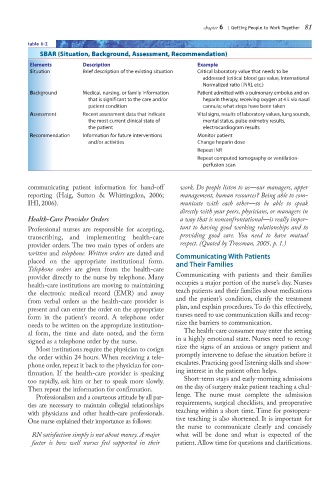
                 table 6-2
                    SBAR (Situation, Background, Assessment, Recommendation)
                 Elements        Description                       Example
                 Situation       Brief description of the existing situation  Critical laboratory value that needs to be
                                                                     addressed (critical blood gas value, International
                                                                     Normalized ratio [INR], etc.)
                 Background      Medical, nursing, or family information   Patient admitted with a pulmonary embolus and on
                                   that is significant to the care and/or    heparin therapy, receiving oxygen at 4 L via nasal
                                   patient condition                 cannula; what steps have been taken
                 Assessment      Recent assessment data that indicate   Vital signs, results of laboratory values, lung sounds,
                                   the most current clinical state of   mental status, pulse oximetry results,
                                   the patient                       electrocardiogram results
                 Recommendation  Information for future interventions  Monitor patient
                                   and/or activities               Change heparin dose
                                                                   Repeat INR
                                                                   Repeat computed tomography or ventilation-
                                                                     perfusion scan


                 communicating patient information for hand-off  work. Do people listen to us—our managers, upper
                 reporting (Haig, Sutton &  Whittingdon, 2006;  management, human resources? Being able to com-
                 IHI, 2006).                                  municate with each other—to be able to speak
                                                              directly with your peers, physicians, or managers in
                 Health-Care Provider Orders                  a way that is nonconfrontational—is really impor-
                 Professional nurses are responsible for accepting,  tant to having good working relationships and to
                 transcribing, and implementing health-care   providing good care. You need to have mutual
                 provider orders. The two main types of orders are  respect. (Quoted by Trossman, 2005, p. 1.)
                 written and telephone. Written orders are dated and  Communicating With Patients
                 placed on the appropriate institutional form.  and Their Families
                 Telephone orders are given from the health-care
                                                             Communicating with patients and their families
                 provider directly to the nurse by telephone. Many
                                                             occupies a major portion of the nurse’s day. Nurses
                 health-care institutions are moving to maintaining
                                                             teach patients and their families about medications
                 the electronic medical record (EMR) and away
                                                             and the patient’s condition, clarify the treatment
                 from verbal orders as the health-care provider is
                                                             plan, and explain procedures. To do this effectively,
                 present and can enter the order on the appropriate
                                                             nurses need to use communication skills and recog-
                 form in the patient’s record. A telephone order
                                                             nize the barriers to communication.
                 needs to be written on the appropriate institution-
                                                               The health-care consumer may enter the setting
                 al form, the time and date noted, and the form
                                                             in a highly emotional state. Nurses need to recog-
                 signed as a telephone order by the nurse.
                                                             nize the signs of an anxious or angry patient and
                   Most institutions require the physician to cosign
                                                             promptly intervene to defuse the situation before it
                 the order within 24 hours. When receiving a tele-
                                                             escalates. Practicing good listening skills and show-
                 phone order,repeat it back to the physician for con-
                                                             ing interest in the patient often helps.
                 firmation. If the health-care provider is speaking
                                                               Short-term stays and early-morning admissions
                 too rapidly, ask him or her to speak more slowly.
                                                             on the day of surgery make patient teaching a chal-
                 Then repeat the information for confirmation.
                                                             lenge. The nurse must complete the admission
                   Professionalism and a courteous attitude by all par-
                                                             requirements, surgical checklists, and preoperative
                 ties are necessary to maintain collegial relationships
                                                             teaching within a short time. Time for postopera-
                 with physicians and other health-care professionals.
                                                             tive teaching is also shortened. It is important for
                 One nurse explained their importance as follows:
                                                             the nurse to communicate clearly and concisely
                  RN satisfaction simply is not about money. A major  what will be done and what is expected of the
                  factor is how well nurses feel supported in their  patient. Allow time for questions and clarifications.

