


Page 100 - ANUAL REPORT MOH 2017
P. 100
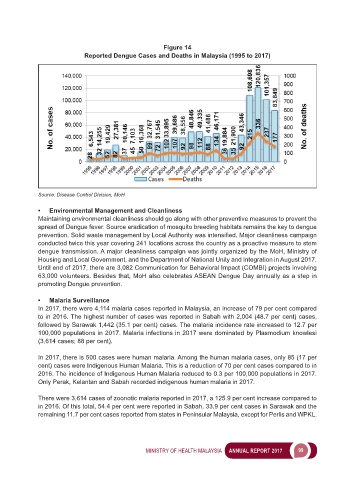
Figure 14
                            Reported Dengue Cases and Deaths in Malaysia (1995 to 2017)


             Source: Disease Control Division, MoH

             •   Environmental Management and Cleanliness
             Maintaining environmental cleanliness should go along with other preventive measures to prevent the
             spread of Dengue fever. Source eradication of mosquito breeding habitats remains the key to dengue
             prevention. Solid waste management by Local Authority was intensified. Major cleanliness campaign
             conducted twice this year covering 241 locations across the country as a proactive measure to stem
             dengue transmission. A major cleanliness campaign was jointly organized by the MoH, Ministry of
             Housing and Local Government, and the Department of National Unity and Integration in August 2017.
             Until end of 2017, there are 3,082 Communication for Behavioral Impact (COMBI) projects involving
             63,000 volunteers. Besides that, MoH also celebrates ASEAN Dengue Day annually as a step in
             promoting Dengue prevention.

             •   Malaria Surveillance
             In 2017, there were 4,114 malaria cases reported in Malaysia, an increase of 79 per cent compared
             to in 2016. The highest number of cases was reported in Sabah with 2,004 (48.7 per cent) cases,
             followed by Sarawak 1,442 (35.1 per cent) cases. The malaria incidence rate increased to 12.7 per
             100,000 populations in 2017. Malaria infections in 2017 were dominated by Plasmodium knowlesi
             (3,614 cases; 88 per cent).

             In 2017, there is 500 cases were human malaria. Among the human malaria cases, only 85 (17 per
             cent) cases were Indigenous Human Malaria. This is a reduction of 70 per cent cases compared to in
             2016. The incidence of Indigenous Human Malaria reduced to 0.3 per 100,000 populations in 2017.
             Only Perak, Kelantan and Sabah recorded indigenous human malaria in 2017.

             There were 3,614 cases of zoonotic malaria reported in 2017, a 125.9 per cent increase compared to
             in 2016. Of this total, 54.4 per cent were reported in Sabah, 33.9 per cent cases in Sarawak and the
             remaining 11.7 per cent cases reported from states in Peninsular Malaysia, except for Perlis and WPKL.


                                                MINISTRY OF HEALTH MALAYSIA     ANNUAL REPORT 2017       99

