


Page 103 - ANUAL REPORT MOH 2017
P. 103
•   Japanese Encephalitis Control Programme
             In 2017, there were 23 reported Japanese Encephalitis cases in Malaysia, a decrease 53 per cent as
             compared to 2016. Sarawak contributed the highest number 43.5 per cent; followed by Kedah 13 per
             cent and Terengganu with 13 per cent. One (1) death recorded last year in Terengganu. The national
             incidence rate decreased from 0.16 per 100,000 populations the previous year to 0.07 in 2017.

             •   Chikungunya Control Programme
             There was increase in Chikungunya cases in 2017 with 270 cases compared to 12 cases in 2016.
             Incidence rate of Chikungunya 0.83 per 100,000 populations. In 2017, there were outbreaks reported
             in Kedah and Selangor. Single case was reported in Kelantan, Johor, Sarawak and Perak.

             CARDIOVASCULAR DISEASE (CVD), DIABETES MELLITUS (DM), CANCER & FRAMEWORK
             CONVENTION ON TOBACCO CONTROL (FCTC) SECTOR
             •   Quality of Care of Diabetes at Primary Health Centres, Malaysia 2013 to 2017
             Diabetes clinical audit were carried out annually at all health clinics MoH that provide diabetes
             management services, to assess the adequacy of diabetes management at MOH health clinics and to
             determine the quality of care of diabetes patients using a standard quality assurance indicator. Table
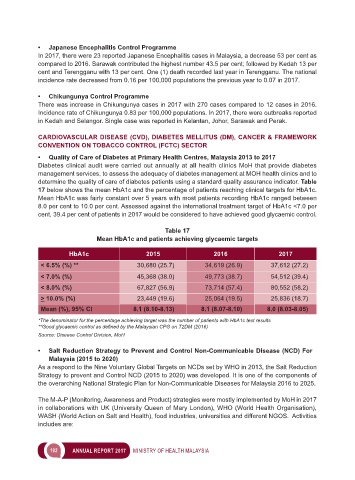
             17 below shows the mean HbA1c and the percentage of patients reaching clinical targets for HbA1c.
             Mean HbA1c was fairly constant over 5 years with most patients recording HbA1c ranged between
             8.0 per cent to 10.0 per cent. Assessed against the international treatment target of HbA1c <7.0 per
             cent, 39.4 per cent of patients in 2017 would be considered to have achieved good glycaemic control.

                                                      Table 17
                                Mean HbA1c and patients achieving glycaemic targets

                       HbA1c                    2015                 2016                 2017
              < 6.5% (%) **                  30,680 (25.7)        34,619 (26.9)         37,612 (27.2)
              < 7.0% (%)                     45,368 (38.0)        49,773 (38.7)         54,512 (39.4)
              < 8.0% (%)                     67,827 (56.9)        73,714 (57.4)         80,552 (58.2)

              > 10.0% (%)                    23,449 (19.6)        25,064 (19.5)         25,836 (18.7)
              Mean (%), 95% CI              8.1 (8.10-8.13)      8.1 (8.07-8.10)      8.0 (8.03-8.05)
             *The denominator for the percentage achieving target was the number of patients with HbA1c test results
             **Good glycaemic control as defined by the Malaysian CPG on T2DM (2016)
             Source: Disease Control Division, MoH

             •   Salt Reduction Strategy to Prevent and Control Non-Communicable Disease (NCD) For
                 Malaysia (2015 to 2020)
             As a respond to the Nine Voluntary Global Targets on NCDs set by WHO in 2013, the Salt Reduction
             Strategy to prevent and Control NCD (2015 to 2020) was developed. It is one of the components of
             the overarching National Strategic Plan for Non-Communicable Diseases for Malaysia 2016 to 2025.

             The M-A-P (Monitoring, Awareness and Product) strategies were mostly implemented by MoH in 2017
             in collaborations with UK (University Queen of Mary London), WHO (World Health Organisation),
             WASH (World Action on Salt and Health), food industries, universities and different NGOS.  Activities
             includes are:


                 102    ANNUAL REPORT 2017     MINISTRY OF HEALTH MALAYSIA

