


Page 87 - ANUAL REPORT MOH 2017
P. 87
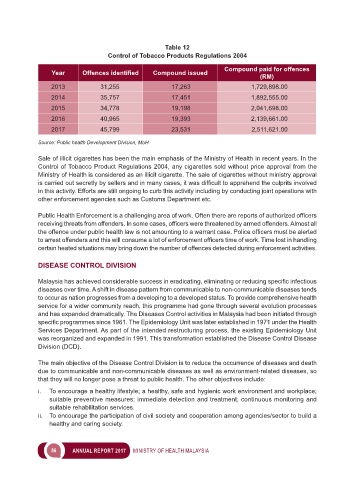
Table 12
                                   Control of Tobacco Products Regulations 2004

                                                                         Compound paid for offences
                  Year     Offences identified    Compound issued
                                                                                    (RM)
                 2013            31,255                 17,263                   1,729,898.00

                 2014            35,757                 17,451                   1,892,555.00
                 2015            34,778                 19,198                   2,041,698.00
                 2016            40,965                 19,393                   2,139,661.00
                 2017            45,799                 23,531                   2,511,621.00

             Source: Public health Development Division, MoH

             Sale of illicit cigarettes has been the main emphasis of the Ministry of Health in recent years. In the
             Control of Tobacco Product Regulations 2004, any cigarettes sold without price approval from the
             Ministry of Health is considered as an illicit cigarette. The sale of cigarettes without ministry approval
             is carried out secretly by sellers and in many cases, it was difficult to apprehend the culprits involved
             in this activity. Efforts are still ongoing to curb this activity including by conducting joint operations with
             other enforcement agencies such as Customs Department etc.

             Public Health Enforcement is a challenging area of work. Often there are reports of authorized officers
             receiving threats from offenders. In some cases, officers were threatened by armed offenders. Almost all
             the offence under public health law is not amounting to a warrant case. Police officers must be alerted
             to arrest offenders and this will consume a lot of enforcement officers time of work. Time lost in handling
             certain heated situations may bring down the number of offences detected during enforcement activities.

             DISEASE CONTROL DIVISION

             Malaysia has achieved considerable success in eradicating, eliminating or reducing specific infectious
             diseases over time. A shift in disease pattern from communicable to non-communicable diseases tends
             to occur as nation progresses from a developing to a developed status. To provide comprehensive health
             service for a wider community reach, this programme had gone through several evolution processes
             and has expanded dramatically. The Diseases Control activities in Malaysia had been initiated through
             specific programmes since 1961. The Epidemiology Unit was later established in 1971 under the Health
             Services Department. As part of the intended restructuring process, the existing Epidemiology Unit
             was reorganized and expanded in 1991. This transformation established the Disease Control Disease
             Division (DCD).


             The main objective of the Disease Control Division is to reduce the occurrence of diseases and death
             due to communicable and non-communicable diseases as well as environment-related diseases, so
             that they will no longer pose a threat to public health. The other objectives include:
             i.   To encourage a healthy lifestyle; a healthy, safe and hygienic work environment and workplace;
                 suitable preventive measures; immediate detection and treatment; continuous monitoring and
                 suitable rehabilitation services.
             ii.  To encourage the participation of civil society and cooperation among agencies/sector to build a
                 healthy and caring society.


                 86     ANNUAL REPORT 2017     MINISTRY OF HEALTH MALAYSIA

