


Page 90 - ANUAL REPORT MOH 2017
P. 90
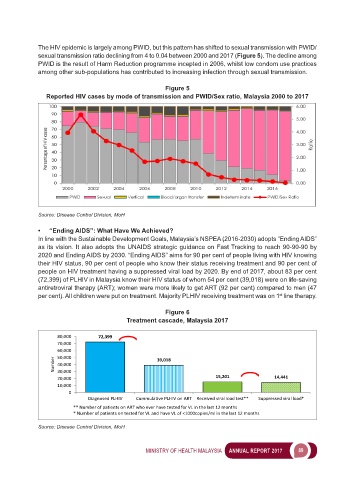
The HIV epidemic is largely among PWID, but this pattern has shifted to sexual transmission with PWID/
             sexual transmission ratio declining from 4 to 0.04 between 2000 and 2017 (Figure 5). The decline among
             PWID is the result of Harm Reduction programme incepted in 2006, whilst low condom use practices
             among other sub-populations has contributed to increasing infection through sexual transmission.

                                                      Figure 5
                Reported HIV cases by mode of transmission and PWID/Sex ratio, Malaysia 2000 to 2017


             Source: Disease Control Division, MoH

             •   “Ending AIDS”: What Have We Achieved?
             In line with the Sustainable Development Goals, Malaysia’s NSPEA (2016-2030) adopts “Ending AIDS”
             as its vision. It also adopts the UNAIDS strategic guidance on Fast Tracking to reach 90-90-90 by
             2020 and Ending AIDS by 2030. “Ending AIDS” aims for 90 per cent of people living with HIV knowing
             their HIV status, 90 per cent of people who know their status receiving treatment and 90 per cent of
             people on HIV treatment having a suppressed viral load by 2020. By end of 2017, about 83 per cent
             (72,399) of PLHIV in Malaysia know their HIV status of whom 54 per cent (39,018) were on life-saving
             antiretroviral therapy (ART); women were more likely to get ART (92 per cent) compared to men (47
             per cent). All children were put on treatment. Majority PLHIV receiving treatment was on 1  line therapy.
                                                                                          st
                                                      Figure 6
                                         Treatment cascade, Malaysia 2017

                   80,000       72,399
                   70,000
                   60,000
                   50,000                          39,018
                  Number  40,000
                   30,000
                   20,000                                             15,201             14,441
                   10,000
                       0                                                            **
                             Diagnosed PLHIV  Cummulative PLHIV on ART  Received viral load test**  Suppressed viral load*
                        ** Number of patients on ART who ever have tested for VL in the last 12 months
                        * Number of patients on tested for VL and have VL of <1000copies/ml in the last 12 months
             Source: Disease Control Division, MoH


                                                MINISTRY OF HEALTH MALAYSIA     ANNUAL REPORT 2017       89

