


Page 91 - ANUAL REPORT MOH 2017
P. 91
VACCINES PREVENTABLE DISEASE AND FOOD & WATERBORNE DISEASE SECTOR
             •   Poliomyelitis
             Malaysia was declared polio-free in October 2000. In 2010, Malaysia has fully utilized the inactivated
             polio vaccine (IPV) for immunization of children. On 20 September 2015, the Global Commission for
             Polio Eradication Certification declared that the Wild Polio Virus Type 2 (WPV2) has been successfully
             eradicated worldwide. The tOPV vaccine given to 7-year-olds in schools in Malaysia as an extra dose
             was discontinued and all the excess tOPV vaccines were centrally disposed at the Institute of Medical
             Research (IMR) in 2016. At the same time, a study was conducted nationwide to ensure no Wild
             Polio Virus type 2 (WPV2) or virus polio 2 that arises from the use of tOPV (VDPV2) is stored in any
             laboratory. In 2017, AFP surveillance has achieved AFP non-polio rates of 2.0 per 100,000 the population
             aged less than 15 years, exceeds the target set by WHO of 1 in 100,000. However, the quality of AFP
             surveillance is still substandard, especially the non-polio enterovirus isolation rate and the percentage
             of AFP cases with adequate stools.

             •   Measles
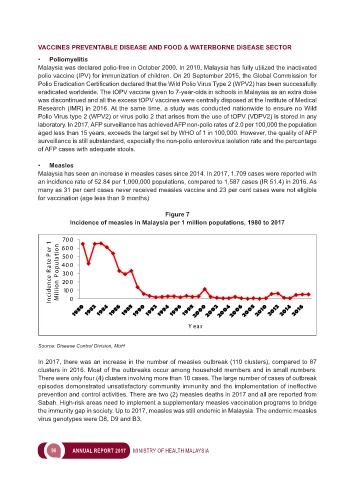
             Malaysia has seen an increase in measles cases since 2014. In 2017, 1,709 cases were reported with
             an incidence rate of 52.84 per 1,000,000 populations, compared to 1,587 cases (IR 51.4) in 2016. As
             many as 31 per cent cases never received measles vaccine and 23 per cent cases were not eligible
             for vaccination (age less than 9 months)

                                                      Figure 7
                       Incidence of measles in Malaysia per 1 million populations, 1980 to 2017

                     70 0
                 Incidence R ate P er 1   Miliion P opulation  40 0
                     60 0
                     50 0


                     30 0
                     20 0
                     10 0
                       0


                                                             Y ear


             Source: Disease Control Division, MoH

             In 2017, there was an increase in the number of measles outbreak (110 clusters), compared to 87
             clusters in 2016. Most of the outbreaks occur among household members and in small numbers.
             There were only four (4) clusters involving more than 10 cases. The large number of cases of outbreak
             episodes demonstrated unsatisfactory community immunity and the implementation of ineffective
             prevention and control activities. There are two (2) measles deaths in 2017 and all are reported from
             Sabah. High-risk areas need to implement a supplementary measles vaccination programs to bridge
             the immunity gap in society. Up to 2017, measles was still endemic in Malaysia. The endemic measles
             virus genotypes were D8, D9 and B3.


                 90     ANNUAL REPORT 2017     MINISTRY OF HEALTH MALAYSIA

