


Page 262 - alligood 8th edition_Neat
P. 262
CHAPTER 14  Dorothea E. Orem  243

           “Deliberate action refers to actions performed by indi-  sciences,  Orem  stated,  “the  isolation,  naming,  and
           vidual  human  beings  who  have  intentions  and  are   description of the two sets of sciences are based on
           conscious of their intentions to bring about, through   my  understanding  of  the  nature  of  the  practical
           their  actions,  conditions  or  states  of  affairs  that  do    sciences,  on  my  knowledge  of  the  organization  of
           not at present exist” (Orem, 2001, pp. 62–63). When   subject  matter  in  other  practice  fields,  and  on  my
           engaging  in  deliberate  action,  the  person  acts  as  an   understanding of components of curricula for edu-
           agent. The view of person-as-agent is also reflected in   cation for the professions” (pp. 174–175).
           the SCDNT’s conceptual elements of the nursing care   In addition to the two components or types of prac-
           and dependent care. In relation to the view of person-  tical science, scientific knowledge necessary for nurs-
           as-agent and the idea of deliberate action, Orem cited   ing practice includes sets of applied sciences and basic
           a  number  of  scholars,  including  Arnold,  Parsons,    non-nursing sciences. In the development of applied
           and Wallace. She identified seven assumptions regard-  sciences, theories from other fields are used to solve
           ing  human  beings  that  pertain  to  deliberate  action   problems in the practice field. These applied nursing
           (Orem, 2001, p. 65). These explicit assumptions, while   sciences  have  yet  to  be  identified  and  developed.
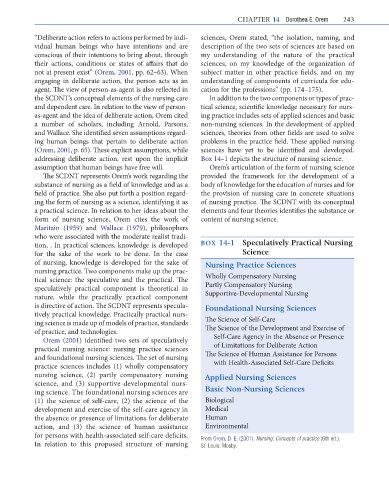
           addressing  deliberate  action,  rest  upon  the  implicit    Box 14–1 depicts the structure of nursing science.
           assumption that human beings have free will.    Orem’s articulation of the form of nursing science
             The SCDNT represents Orem’s work regarding the   provided  the  framework  for  the  development  of  a
           substance of nursing as a field of knowledge and as a   body of knowledge for the education of nurses and for
           field of practice. She also put forth a position regard-  the  provision  of  nursing  care  in  concrete  situations
           ing the form of nursing as a science, identifying it as   of nursing practice. The SCDNT with its conceptual
           a practical science. In relation to her ideas about the   elements and four theories identifies the substance or
           form  of  nursing  science,  Orem  cites  the  work  of   content of nursing science.
           Maritain  (1959)  and  Wallace  (1979),  philosophers
           who were associated with the moderate realist tradi-
           tion, . In practical sciences, knowledge is developed   BOX 14-1   Speculatively Practical Nursing
           for  the  sake  of  the  work  to  be  done.  In  the  case    Science
           of  nursing,  knowledge  is  developed  for  the  sake  of   Nursing Practice Sciences
           nursing practice. Two components make up the prac-
           tical  science:  the  speculative  and  the  practical.  The   Wholly Compensatory Nursing
           speculatively  practical  component  is  theoretical  in   Partly Compensatory Nursing
           nature,  while  the  practically  practical  component    Supportive-Developmental Nursing
           is directive of action. The SCDNT represents specula-  Foundational Nursing Sciences
           tively practical knowledge. Practically practical nurs-
           ing science is made up of models of practice, standards   The Science of Self-Care
           of practice, and technologies.                 The Science of the Development and Exercise of
             Orem  (2001)  identified  two  sets  of  speculatively   Self-Care Agency in the Absence or Presence
           practical  nursing  science:  nursing  practice  sciences   of Limitations for Deliberate Action
           and foundational nursing sciences. The set of nursing   The Science of Human Assistance for Persons
           practice  sciences  includes  (1)  wholly  compensatory   with Health-Associated Self-Care Deficits
           nursing  science,  (2)  partly  compensatory  nursing   Applied Nursing Sciences
           science,  and  (3)  supportive  developmental  nurs-
           ing science. The foundational nursing sciences are   Basic Non-Nursing Sciences
           (1)  the  science  of  self-care,  (2)  the  science  of  the   Biological
           development and exercise of the self-care agency in   Medical
           the absence or presence of limitations for deliberate   Human
           action,  and  (3)  the  science  of  human  assistance    Environmental
           for persons with health-associated self-care deficits.   From Orem, D. E. (2001). Nursing: Concepts of practice (6th ed.).
           In  relation  to  this  proposed  structure  of  nursing    St. Louis: Mosby.

