


Page 268 - alligood 8th edition_Neat
P. 268
CHAPTER 14  Dorothea E. Orem  249

           and dependent care are parallel, with the main dif-  operational or become operational in the production
           ference  that  when  providing  dependent-care,  the   of  nursing  systems,  systems  of  care  for  individuals
           person  is  meeting  the  self-care  needs  of  another   or  for  dependent-care  units  or  multi-person  units
           person. For the dependent-care agent, the demands   served  by  nurses”  (Orem,  1997,  p.  31).  The  overall
           of providing dependent care can influence or condition   theory is logically congruent.
           the agent’s therapeutic self-care demand and self-care
           agency.  The  need  for  dependent-care  is  expected  to
           grow with the increasing age of the population and   Acceptance by the Nursing Community
           the number of persons living with chronic and/or   Orem’s  SCDNT  has  achieved  a  significant  level  of
           disabling conditions.                         acceptance by the international nursing community,
                                                         as evidenced by the magnitude of published material
                                                         and presentations at the International Orem Society
            Logical Form                                 World Congresses (2008, 2011, and 2012). In research
           Orem’s insight led to her initial formalization and   using the SCDNT or components, Biggs (2008) found
           subsequent expression of a general concept of nurs-  more  than  800  references.  Berbiglia  identified  se-
           ing. This generalization then made possible induc-  lected practice settings and SCDNT conceptual foci
           tive  and  deductive  thinking  about  nursing.  The   from a review of more than 3 decades of use of the
           form  of  the  theory  is  shown  in  the  many  models   SCDNT  in  practice  and  research  and  publicized
           that  Orem  and  others  have  developed,  such  as   selected  international  SCDNT  practice  models  for
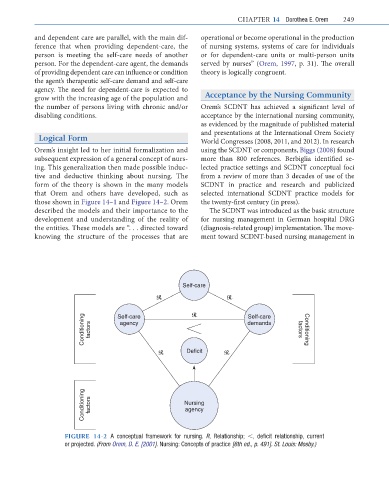
           those shown in Figure 14–1 and Figure 14–2. Orem   the twenty-first century (in press).
           described the models and their importance to the   The SCDNT was introduced as the basic structure
           development  and  understanding  of  the  reality  of   for  nursing  management  in  German  hospital  DRG
           the entities. These models are “. . . directed toward   (diagnosis-related group) implementation. The move-
           knowing  the  structure  of  the  processes  that  are    ment toward SCDNT-based nursing management in


                                                    Self-care


                        Conditioning   factors   Self-care            Self-care     factors   Conditioning
                                                                      demands
                                  agency


                                                     Deficit


                        Conditioning   factors      Nursing

                                                    agency


                   FIGURE  14-2   A  conceptual  framework  for  nursing.  R,  Relationship;  ,,  deficit  relationship,  current
                   or projected. (From Orem, D. E. [2001]. Nursing: Concepts of practice [6th ed., p. 491]. St. Louis: Mosby.)

