


Page 340 - alligood 8th edition_Neat
P. 340
CHAPTER 17  Sister Callista Roy  321

           adaptation  level.  A  person’s  adaptation  level  may  be   time. The basic need of the self-concept mode is psy-
           integrated, compensatory, or compromised.     chic or spiritual integrity. The self-concept is a com-
             Coping  mechanisms  refer  to  innate  or  acquired   posite  belief  about  self  that  is  formed  from  internal
           processes that a person uses to deal with environmen-  perceptions  and  the  perceptions  of  others.  The  self-
           tal stimuli. Coping mechanisms may be categorized   concept mode is composed of the physical self (body
           broadly as the regulator or cognator subsystem. The   sensation and body image) and the personal self (self-
           regulator subsystem responds automatically through   consistency, self-ideal, and the moral-ethical-spiritual
           innate neural, chemical, and endocrine coping pro-  self).  The  role  function  mode  refers  to  the  primary,
           cesses.  The  cognator  subsystem  responds  through    secondary,  and  tertiary  roles  a  person  performs  in
           innate and acquired cognitive-emotive processes that   society.
           include perceptual and information processing, learn-  The basic need of the role function adaptive mode
           ing, judgment, and emotion.                   is social integrity or for one to know how to behave and
             Behaviors that manifest adaptation can be observed   what is expected of him or her in society. The interde-
           in four adaptive modes. The physiological mode refers   pendence  adaptive  mode  refers  to  relationships
           to the person’s physical responses to the environment,   among people. The basic need of the interdependence
           and  the  underlying  need  is  physiological  integrity.    adaptive mode is social integrity or to give and receive
           The self-concept mode refers to a person’s thoughts,   love,  respect,  and  value  from  significant  others  and
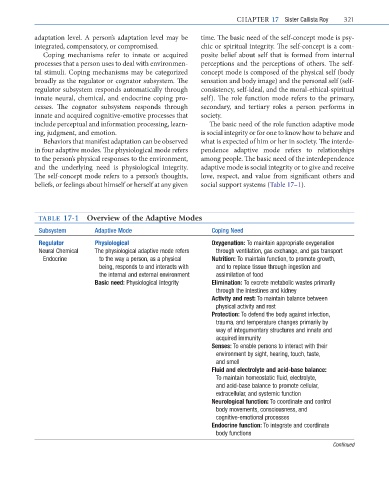
           beliefs, or feelings about himself or herself at any given   social support systems (Table 17–1).


            TABLE 17-1  Overview of the Adaptive Modes
            Subsystem      Adaptive Mode                    Coping Need
            Regulator      Physiological                    Oxygenation: To maintain appropriate oxygenation
            Neural Chemical    The physiological adaptive mode refers    through ventilation, gas exchange, and gas transport
             Endocrine       to the way a person, as a physical    Nutrition: To maintain function, to promote growth,
                             being, responds to and interacts with   and to replace tissue through ingestion and
                             the internal and external environment  assimilation of food
                           Basic need: Physiological integrity  Elimination: To excrete metabolic wastes primarily
                                                             through the intestines and kidney
                                                            Activity and rest: To maintain balance between
                                                             physical activity and rest
                                                            Protection: To defend the body against infection,
                                                             trauma, and temperature changes primarily by
                                                             way of integumentary structures and innate and
                                                             acquired immunity
                                                            Senses: To enable persons to interact with their
                                                             environment by sight, hearing, touch, taste,
                                                             and smell
                                                            Fluid and electrolyte and acid-base balance:
                                                             To maintain homeostatic fluid, electrolyte,
                                                             and acid-base balance to promote cellular,
                                                             extracellular, and systemic function
                                                            Neurological function: To coordinate and control
                                                             body movements, consciousness, and
                                                             cognitive-emotional processes
                                                            Endocrine function: To integrate and coordinate
                                                             body functions
                                                                                             Continued

