


Page 537 - alligood 8th edition_Neat
P. 537
518    UNIT IV  Nursing Theories

            Appendix

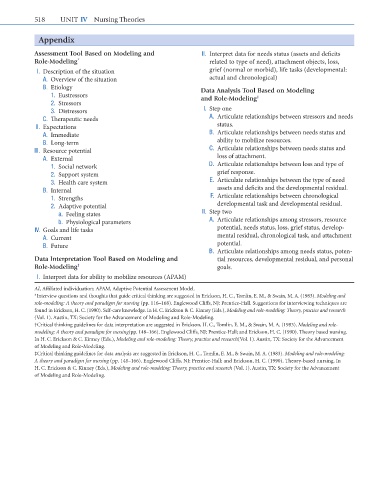
           Assessment Tool Based on Modeling and          II.  Interpret data for needs status (assets and deficits
           Role-Modeling *                                 related to type of need), attachment objects, loss,
             I.  Description of the situation              grief (normal or morbid), life tasks (developmental:
              A.  Overview of the situation                actual and chronological)
              B.  Etiology                               Data Analysis Tool Based on Modeling
                1.  Eustressors                          and Role-Modeling ‡
                2.  Stressors
                3.  Distressors                            I.  Step one
              C.  Therapeutic needs                         A.  Articulate relationships between stressors and needs
            II.  Expectations                                status.
              A.  Immediate                                 B.  Articulate relationships between needs status and
              B.  Long-term                                  ability to mobilize resources.
             III.  Resource potential                       C.  Articulate relationships between needs status and
              A.  External                                   loss of attachment.
                1.  Social network                          D.  Articulate relationships between loss and type of
                2.  Support system                           grief response.
                3.  Health care system                      E.  Articulate relationships between the type of need
              B.  Internal                                   assets and deficits and the developmental residual.
                1.  Strengths                               F.  Articulate relationships between chronological
                2.  Adaptive potential                       developmental task and developmental residual.
                  a.  Feeling states                      II.  Step two
                  b.  Physiological parameters              A.  Articulate relationships among stressors, resource
            IV.  Goals and life tasks                        potential, needs status, loss, grief status, develop-
              A.  Current                                    mental residual, chronological task, and attachment
              B.  Future                                     potential.
                                                            B.  Articulate relationships among needs status, poten-
           Data Interpretation Tool Based on Modeling and    tial resources, developmental residual, and personal
           Role-Modeling †                                   goals.
             I.  Interpret data for ability to mobilize resources (APAM)

           AI, Affiliated individuation; APAM, Adaptive Potential Assessment Model.
           *Interview questions and thoughts that guide critical thinking are suggested in Erickson, H. C., Tomlin, E. M., & Swain, M. A. (1983). Modeling and
           role-modeling: A theory and paradigm for nursing (pp. 116–168). Englewood Cliffs, NJ: Prentice-Hall. Suggestions for interviewing techniques are
           found in Erickson, H. C. (1990). Self-care knowledge. In H. C. Erickson & C. Kinney (Eds.), Modeling and role-modeling: Theory, practice and research
           (Vol. 1). Austin, TX: Society for the Advancement of Modeling and Role-Modeling.
           †Critical thinking guidelines for data interpretation are suggested in Erickson, H. C., Tomlin, E. M., & Swain, M. A. (1983). Modeling and role-
           modeling: A theory and paradigm for nursing(pp. 148–166). Englewood Cliffs, NJ: Prentice-Hall; and Erickson, H. C. (1990). Theory based nursing.
           In H. C. Erickson & C. Kinney (Eds.), Modeling and role-modeling: Theory, practice and research(Vol. 1). Austin, TX: Society for the Advancement
           of Modeling and Role-Modeling.
           ‡Critical thinking guidelines for data analysis are suggested in Erickson, H. C., Tomlin, E. M., & Swain, M. A. (1983). Modeling and role-modeling:
           A theory and paradigm for nursing (pp. 148–166). Englewood Cliffs, NJ: Prentice-Hall; and Erickson, H. C. (1990). Theory-based nursing. In
           H. C. Erickson & C. Kinney (Eds.), Modeling and role-modeling: Theory, practice and research (Vol. 1). Austin, TX: Society for the Advancement
           of Modeling and Role-Modeling.

