


Page 551 - alligood 8th edition_Neat
P. 551
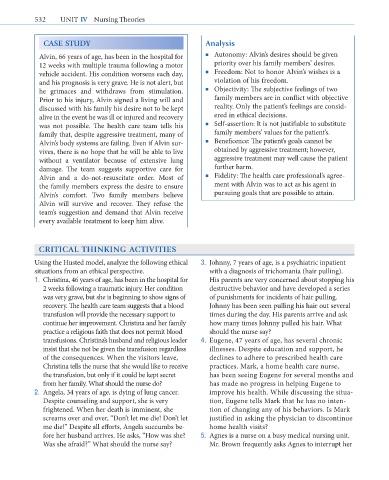
532    UNIT IV  Nursing Theories


             CASE STUDY                                   Analysis
            Alvin, 66 years of age, has been in the hospital for   n	 Autonomy: Alvin’s desires should be given
            12 weeks with multiple trauma following a motor   priority over his family members’ desires.
            vehicle accident. His condition worsens each day,   n	 Freedom: Not to honor Alvin’s wishes is a
            and his prognosis is very grave. He is not alert, but   violation of his freedom.
            he  grimaces  and  withdraws  from  stimulation.   n	 Objectivity: The subjective feelings of two
            Prior to his injury, Alvin signed a living will and   family members are in conflict with objective
            discussed with his family his desire not to be kept   reality. Only the patient’s feelings are consid-
            alive in the event he was ill or injured and recovery   ered in ethical decisions.
            was  not  possible.  The  health  care  team  tells  his   n	 Self-assertion: It is not justifiable to substitute
            family that, despite aggressive treatment, many of   family members’ values for the patient’s.
            Alvin’s body systems are failing. Even if Alvin sur-  n	 Beneficence: The patient’s goals cannot be
            vives, there is no hope that he will be able to live   obtained by aggressive treatment; however,
            without  a  ventilator  because  of  extensive  lung   aggressive treatment may well cause the patient
            damage.  The  team  suggests  supportive  care  for   further harm.
            Alvin  and  a  do-not-resuscitate  order.  Most  of    n	 Fidelity: The health care professional’s agree-
            the family members express the desire to ensure   ment with Alvin was to act as his agent in
            Alvin’s  comfort.  Two  family  members  believe    pursuing goals that are possible to attain.
            Alvin  will  survive  and  recover.  They  refuse  the
            team’s suggestion and demand that Alvin receive
            every available treatment to keep him alive.


            CRITICAL THINKING ACTIVITIES

           Using the Husted model, analyze the following ethical     3.  Johnny, 7 years of age, is a psychiatric inpatient
           situations from an ethical perspective.         with a diagnosis of trichomania (hair pulling).
            1.  Christina, 46 years of age, has been in the hospital for   His parents are very concerned about stopping his
             2 weeks following a traumatic injury. Her condition   destructive behavior and have developed a series
             was very grave, but she is beginning to show signs of   of punishments for incidents of hair pulling.
             recovery. The health care team suggests that a blood   Johnny has been seen pulling his hair out several
             transfusion will provide the necessary support to   times during the day. His parents arrive and ask
             continue her improvement. Christina and her family   how many times Johnny pulled his hair. What
             practice a religious faith that does not permit blood   should the nurse say?
             transfusions. Christina’s husband and religious leader     4.  Eugene, 47 years of age, has several chronic
             insist that she not be given the transfusion regardless   illnesses. Despite education and support, he
             of the consequences. When the visitors leave,    declines to adhere to prescribed health care
             Christina tells the nurse that she would like to receive   practices. Mark, a home health care nurse,
             the transfusion, but only if it could be kept secret   has been seeing Eugene for several months and
             from her family. What should the nurse do?    has made no progress in helping Eugene to
             2.  Angela, 34 years of age, is dying of lung cancer.   improve his health. While discussing the situa-
             Despite counseling and support, she is very   tion, Eugene tells Mark that he has no inten-
             frightened. When her death is imminent, she   tion of changing any of his behaviors. Is Mark
             screams over and over, “Don’t let me die! Don’t let   justified in asking the physician to discontinue
             me die!” Despite all efforts, Angela succumbs be-  home health visits?
             fore her husband arrives. He asks, “How was she?     5.  Agnes is a nurse on a busy medical nursing unit.
             Was she afraid?” What should the nurse say?   Mr. Brown frequently asks Agnes to interrupt her

