


Page 617 - alligood 8th edition_Neat
P. 617
598    UNIT V  Middle Range Nursing Theories

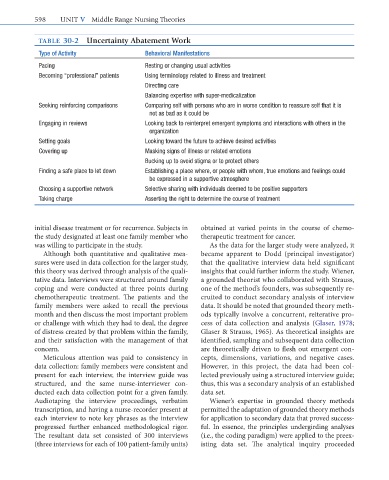
            TABLE 30-2   Uncertainty Abatement Work
            Type of Activity             Behavioral Manifestations

            Pacing                       Resting or changing usual activities
            Becoming “professional” patients  Using terminology related to illness and treatment
                                         Directing care
                                         Balancing expertise with super-medicalization
            Seeking reinforcing comparisons  Comparing self with persons who are in worse condition to reassure self that it is
                                           not as bad as it could be
            Engaging in reviews          Looking back to reinterpret emergent symptoms and interactions with others in the
                                           organization
            Setting goals                Looking toward the future to achieve desired activities
            Covering up                  Masking signs of illness or related emotions
                                         Bucking up to avoid stigma or to protect others
            Finding a safe place to let down  Establishing a place where, or people with whom, true emotions and feelings could
                                           be expressed in a supportive atmosphere
            Choosing a supportive network  Selective sharing with individuals deemed to be positive supporters
            Taking charge                Asserting the right to determine the course of treatment


           initial disease treatment or for recurrence. Subjects in   obtained  at  varied  points  in  the  course  of  chemo-
           the study designated at least one family member who   therapeutic treatment for cancer.
           was willing to participate in the study.        As the data for the larger study were analyzed, it
             Although  both  quantitative  and  qualitative  mea-  became  apparent  to  Dodd  (principal  investigator)
           sures were used in data collection for the larger study,   that  the  qualitative  interview  data  held  significant
           this theory was derived through analysis of the quali-  insights that could further inform the study. Wiener,
           tative data. Interviews were structured around family   a grounded theorist who collaborated with Strauss,
           coping  and  were  conducted  at  three  points  during   one of the method’s founders, was subsequently re-
           chemotherapeutic  treatment.  The  patients  and  the   cruited to conduct secondary analysis of interview
           family  members  were  asked  to  recall  the  previous   data. It should be noted that grounded theory meth-
           month and then discuss the most important problem   ods typically involve a concurrent, reiterative pro-
           or challenge with which they had to deal, the degree   cess  of  data  collection  and  analysis  (Glaser,  1978;
           of distress created by that problem within the family,   Glaser & Strauss, 1965). As theoretical insights are
           and  their  satisfaction  with  the  management  of  that   identified, sampling and subsequent data collection
           concern.                                      are theoretically driven to flesh out emergent con-
             Meticulous  attention  was  paid  to  consistency  in   cepts,  dimensions,  variations,  and  negative  cases.
           data collection: family members were consistent and   However,  in  this  project,  the  data  had  been  col-
           present  for  each  interview,  the  interview  guide  was   lected previously using a structured interview guide;
           structured,  and  the  same  nurse-interviewer  con-  thus, this was a secondary analysis of an established
           ducted each data collection point for a given family.   data set.
           Audiotaping  the  interview  proceedings,  verbatim   Wiener’s  expertise  in  grounded  theory  methods
           transcription, and having a nurse-recorder present at   permitted the adaptation of grounded theory methods
           each interview to note key phrases as the interview   for application to secondary data that proved success-
           progressed  further  enhanced  methodological  rigor.   ful.  In  essence,  the  principles  undergirding  analyses
           The  resultant  data  set  consisted  of  300  interviews   (i.e., the coding paradigm) were applied to the preex-
           (three interviews for each of 100 patient-family units)   isting  data  set.  The  analytical  inquiry  proceeded

