


Page 662 - alligood 8th edition_Neat
P. 662
CHAPTER 32  Phil Barker  643

           and  relationships  are  described  carefully,  specifically,   The  Holistic  Assessment,  the  person’s  story,  is  at
           and metaphorically, though not necessarily concisely.    the  heart  of  care  planning  and  is  represented  as  a
           It  is  Barker’s  terms  like  “problems  in  living,”  mental   heart. The circle of security assessment and plan sur-
           distress,  and  view  of  people  experiencing  problems    rounds the heart, all of which is surrounded by the
           as “persons” that guide nurses to a proper focus. The   interprofessional team circle (Figure 32–2).
           identification  of  “human  needs”  rather  than  psycho-  The  continuum  of  care  (immediate,  transitional,
           logical, social, or physical needs also provides clarity   and developmental) intersects with the focus of care
           and focus. How nurses see persons and how persons   (Barker,  2000e;  Barker  &  Buchanan-Barker,  2007a)
           want  to  be  nursed  are  clearly  illustrated  through    (Figure 32–3).
           the  core  category  of  “knowing  you,  knowing  me.”   Barker  and  Buchanan-Barker  (2007a)  provide  a
           Three subcategories, ordinary me, pseudo-ordinary or   map or overview of the continuum of care or voyage
           engineered-me,  and  professional  me  each  have  four   of  the  person  who  enters,  progresses  through,  and
           dimensions:  depth  of  knowing,  power,  time,  and   exits the service (Figure 32–4).
           translation  (Barker,  Jackson,  &  Stevenson,  1999a;   This easily understood theory is accessible concep-
           Jackson & Stevenson, 2004).                   tually and linguistically through the use of everyday
             In practice, using the person’s own language, rather   language.
           than jargon or professional language, contributes to
           the theory’s success and its clarity. Major concepts of   Simplicity
           collaboration,  empowerment,  relationships,  solution   The Tidal Model is based upon a few simple ideas
           focus,  empowering  through  relationships,  narrative,   about  “being  human”  and  “helping  one  another”
           and  the  use  of  “problems  in  living”  are  sufficiently   (Barker,  2000e).  It  is  comprehensive,  elegant  in  its
           clear and open the theory for use in other areas of   simplicity, and at a level of abstraction to guide prac-
           nursing and health care.                      tice,  education,  research,  and  policy.  However,  the
             A  number  of  concepts  and  relationships  are  pre-  concepts  themselves  are  complex,  and  the  broad
           sented  elegantly  and  schematically  within  the  Tidal   relationships among the concepts add to the com-
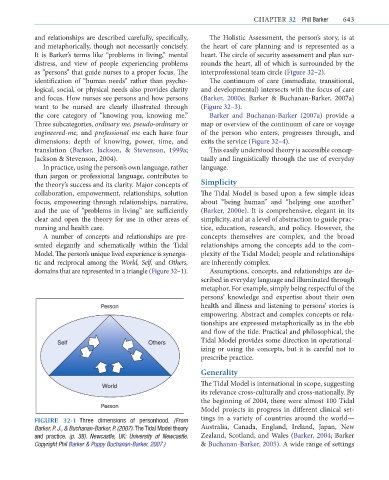
           Model. The person’s unique lived experience is synergis-  plexity of the Tidal Model; people and relationships
           tic  and  reciprocal  among  the  World,  Self,  and  Others,   are inherently complex.
           domains that are represented in a triangle (Figure 32–1).  Assumptions, concepts, and relationships are de-
                                                         scribed in everyday language and illuminated through
                                                         metaphor. For example, simply being respectful of the
                                                         persons’  knowledge  and  expertise  about  their  own
                             Person                      health and illness and listening to persons’ stories is
                                                         empowering. Abstract and complex concepts or rela-
                                                         tionships are expressed metaphorically as in the ebb
                                                         and flow of the tide. Practical and philosophical, the
                                                         Tidal Model provides some direction in operational-
                 Self                     Others
                                                         izing  or  using  the  concepts,  but  it  is  careful  not  to
                                                         prescribe practice.

                                                         Generality
                                                         The Tidal Model is international in scope, suggesting
                             World
                                                         its relevance cross-culturally and cross-nationally. By
                                                         the beginning of 2004, there were almost 100 Tidal
                             Person                      Model projects in progress in different clinical set-
           FIGURE  32-1   Three  dimensions  of  personhood.  (From   tings  in  a  variety  of  countries  around  the  world—
           Barker, P. J., & Buchanan-Barker, P. (2007). The Tidal Model theory   Australia,  Canada,  England,  Ireland,  Japan,  New
           and  practice.  (p.  38).  Newcastle,  UK:  University  of  Newcastle.   Zealand, Scotland, and Wales (Barker, 2004; Barker
           Copyright Phil Barker & Poppy Buchanan-Barker, 2007.)  & Buchanan-Barker, 2005). A wide range of settings

