


Page 735 - alligood 8th edition_Neat
P. 735
716    UNIT VI  The Future of Nursing Theory

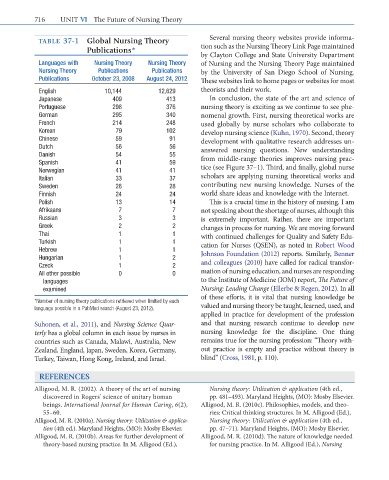
            TABLE 37-1   Global Nursing Theory             Several nursing theory websites provide informa-
                         Publications*                   tion such as the Nursing Theory Link Page maintained
                                                         by Clayton College and State University Department
            Languages with   Nursing Theory   Nursing Theory   of Nursing and the Nursing Theory Page maintained
            Nursing Theory   Publications    Publications    by  the  University  of  San  Diego  School  of  Nursing.
            Publications   October 23, 2008  August 24, 2012  These websites link to home pages or websites for most
            English           10,144         12,629      theorists and their work.
            Japanese            409            413         In conclusion, the state of the art and science of
            Portuguese          298            376       nursing theory is exciting as we continue to see phe-
            German              295            340       nomenal growth. First, nursing theoretical works are
            French              214            248       used  globally  by  nurse  scholars  who  collaborate  to
            Korean               79            102       develop nursing science (Kuhn, 1970). Second, theory
            Chinese              59             91       development with qualitative research addresses un-
            Dutch                56             56       answered  nursing  questions.  New  understanding
            Danish               54             55       from middle-range theories improves nursing prac-
            Spanish              41             59
            Norwegian            41             41       tice (see Figure 37–1). Third, and finally, global nurse
            Italian              33             37       scholars are applying nursing theoretical works and
            Sweden               28             28       contributing new nursing knowledge. Nurses of the
            Finnish              24             24       world share ideas and knowledge with the Internet.
            Polish               13             14         This is a crucial time in the history of nursing. I am
            Afrikaans             7              7       not speaking about the shortage of nurses, although this
            Russian               3              3       is  extremely  important.  Rather,  there  are  important
            Greek                 2              2       changes in process for nursing. We are moving forward
            Thai                  1              1       with continued challenges for Quality and Safety Edu-
            Turkish               1              1       cation for Nurses (QSEN), as noted in Robert Wood
            Hebrew                1              1       Johnson Foundation (2012) reports. Similarly, Benner
            Hungarian             1              2
            Czeck                 1              2       and colleagues (2010) have called for radical transfor-
            All other possible    0              0       mation of nursing education, and nurses are responding
             languages                                   to the Institute of Medicine (IOM) report, The Future of
             examined                                    Nursing: Leading Change (Ellerbe & Regen, 2012). In all
                                                         of  these  efforts,  it  is  vital  that  nursing  knowledge  be
           *Number of nursing theory publications retrieved when limited by each   valued and nursing theory be taught, learned, used, and
           language possible in a PubMed search (August 23, 2012).
                                                         applied in practice for development of the profession
           Suhonen, et al., 2011), and Nursing Science Quar-  and  that  nursing  research  continue  to  develop  new
           terly has a global column in each issue by nurses in   nursing  knowledge  for  the  discipline.  One  thing
           countries such as Canada, Malawi, Australia, New   remains true for the nursing profession: “Theory with-
           Zealand, England, Japan, Sweden, Korea, Germany,   out  practice  is  empty  and  practice  without  theory  is
           Turkey, Taiwan, Hong Kong, Ireland, and Israel.  blind” (Cross, 1981, p. 110).

            REFERENCES

           Alligood, M. R. (2002). A theory of the art of nursing   Nursing theory: Utilization & application (4th ed.,
             discovered in Rogers’ science of unitary human    pp. 481–493). Maryland Heights, (MO): Mosby Elsevier.
             beings. International Journal for Human Caring, 6(2),   Alligood, M. R. (2010c). Philosophies, models, and theo-
             55–60.                                        ries: Critical thinking structures. In M. Alligood (Ed.),
           Alligood, M. R. (2010a). Nursing theory: Utilization & applica-  Nursing theory: Utilization & application (4th ed.,
             tion (4th ed.). Maryland Heights, (MO): Mosby Elsevier.  pp. 47–71). Maryland Heights, (MO): Mosby Elsevier.
           Alligood, M. R. (2010b). Areas for further development of   Alligood, M. R. (2010d). The nature of knowledge needed
             theory-based nursing practice. In M. Alligood (Ed.),   for nursing practice. In M. Alligood (Ed.), Nursing

